

Share This Blog Post
BigCommerce website design gets a lot of attention on its own — but for sellers running eBay or Amazon alongside it, the harder problem is usually keeping all three in sync. A polished main site paired with a disconnected marketplace presence undercuts the very brand consistency a bespoke build is meant to deliver. This guide focuses on that specific gap: building a BigCommerce storefront that actually works as part of a multi-channel setup, not just a standalone site.
As a certified partner across BigCommerce, eBay, and Amazon, we’ll show you how to bridge the gap between visual design and backend logic across every channel you sell on — not just your main site.
Key Takeaways
- Learn how brand storytelling and conversion rate optimization work together in a BigCommerce build.
- Understand why mobile-first architecture matters for a modern storefront’s user experience.
- See how to weigh a bespoke BigCommerce build against a standard template based on your catalogue and integration needs.
- Learn how to keep BigCommerce, eBay, and Amazon visually and operationally in sync as you scale.
- Understand the Frooition methodology for aligning business objectives with technical execution from the discovery phase onward.
Defining BigCommerce Multi-Channel Selling
Multi-channel BigCommerce selling means your main store and your marketplace presence work as one coordinated system rather than three separate projects. Where a basic store just lists products, a properly integrated setup keeps design, inventory, and brand consistent no matter where a customer encounters you first — your own site, eBay, or Amazon.
Standard off-the-shelf templates often struggle here, since they’re built for a single storefront in isolation rather than a brand operating across channels. Frooition’s approach — custom BigCommerce design — is built around “design that sells”: storefronts designed to work as part of your wider selling operation, not just a site on its own.
The Evolution of the BigCommerce Storefront
The BigCommerce platform has grown well beyond its early roots into a modern, flexible commerce architecture. The Stencil framework gives designers real freedom to build dynamic, responsive layouts without fighting the platform’s constraints. Design priorities have shifted toward faster load times and more thoughtful, predictive UX — features that matter more as customers expect a storefront to just work, quickly, on any device.
Why Brand Identity Matters for Conversion
Professional branding carries real weight with buyers. A generic-looking store makes it harder to compete for higher-value customers, since visual polish is one of the first signals a visitor uses to judge whether a business is trustworthy. Bespoke BigCommerce design helps your store avoid looking like every other seller on the platform. Consistency across every touchpoint — not just your homepage — is what turns a first-time visitor into a repeat customer.
- Bespoke Layouts: Break free from the constraints of standard grids to showcase your unique value proposition.
- Data-Driven UX: Design decisions informed by real user behaviour on your store, not generic assumptions.
- Scalable Architecture: Design that grows with your catalog, so performance doesn’t degrade as you expand.
The Core Pillars of a Conversion-Focused BigCommerce Storefront
A high-performing store isn’t built on aesthetics alone — it needs a real synergy between data-driven architecture and creative design. Mobile-first design is foundational, not optional, for any serious BigCommerce build today. We build stores that anticipate how customers actually browse and buy, prioritising technical health and user intent over generic, off-the-shelf defaults.
Personalisation is increasingly a core part of a modern storefront rather than a bolt-on extra — adapting product recommendations and content based on how a specific visitor is actually shopping, rather than showing everyone the same static layout.
UI/UX Design: Beyond Simple Navigation
Modern customers want to find what they’re looking for quickly and without friction. For brands with complex inventories, that requires real architectural thought:
- Faceted search and filtering that stays fast and usable even across large catalogues.
- Rich interactive media — including 3D models where relevant — that helps buyers understand a product before they commit to buying it.
- Persistent carts and streamlined checkout flows that reduce unnecessary friction.
Performance Engineering and Page Speed
Speed is both a ranking factor and a conversion factor. Our technical team focuses on custom code optimisation to strip away the bloat typically found in multi-purpose templates, alongside image optimisation and proper lazy loading, keeping pages fast on mobile as well as desktop. We build to Google’s Core Web Vitals standards to help keep your store both fast and search-visible. If you’re ready to look at what that means for your store, custom BigCommerce design is the natural next step.
Leveraging Headless Commerce for Ultimate Flexibility
Headless commerce is worth considering for larger brands that want total creative freedom over their front end. By decoupling the presentation layer from the BigCommerce backend, designers can build genuinely bespoke experiences without fighting backend constraints — useful for retailers who’ve outgrown standard templates or need to integrate specific third-party tools. It’s worth considering if your current site’s front-end complexity is holding back performance, or if your brand needs an identity that goes well beyond a standard grid layout.
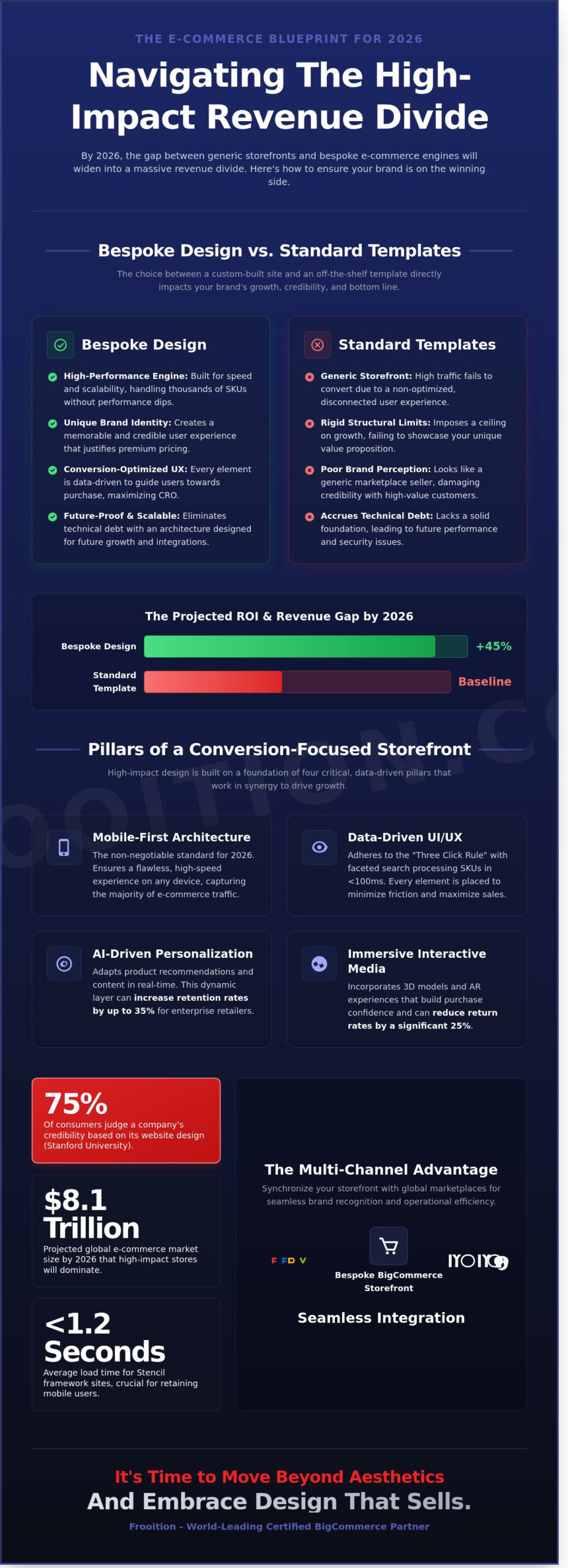
Bespoke Design vs. Standard Templates: Navigating the ROI Gap
Choosing between a low-cost pre-built theme and a bespoke build comes down to short-term savings versus long-term scalability. Standard templates get you to market fast, but they often carry technical debt that becomes a real constraint as you grow — rigid code limits your ability to innovate or pivot later. A bespoke BigCommerce build removes those barriers, supporting integrations templates typically don’t — things like advanced inventory logic or custom API connections. Much like our approach to Shopify custom theme development, the goal is moving past generic aesthetics toward a genuine competitive advantage.
When Is a Template “Good Enough”?
Templates serve a real purpose for early-stage stores. If you’re managing a small catalogue or testing a new market on a limited budget, a standard theme keeps overhead low while you validate the idea. These themes eventually become a bottleneck, though. Signs you’ve likely outgrown your current theme:
- Page Load Bloat: Load speeds dropping due to heavy, unused theme code.
- Mobile Friction: A mobile conversion rate that’s noticeably behind your desktop numbers.
- Functional Limits: You can’t implement B2B pricing tiers or complex product bundles.
- Brand Dilution: Your storefront looks close to indistinguishable from other sellers on the same theme.
Calculating the Real Value of Custom Development
The case for custom development is a financial one as much as a visual one. Even a modest improvement in conversion rate compounds meaningfully over a year of trading — the actual return depends on your traffic, average order value, and starting conversion rate, so it’s worth working through the specific numbers for your store rather than relying on a generic industry average. That return compounds further with the SEO benefits of a genuinely well-structured, fast-loading site. If you’re ready to make the move, our guide on how to find a BigCommerce designer covers what to look for in a partner.
The Multi-Channel Advantage: Integrating BigCommerce with eBay and Amazon
Scaling an e-commerce brand takes more than a standalone storefront — it needs a cohesive setup where every channel reinforces the same brand. Our focus is creating real harmony between your BigCommerce store and your marketplace presence, not just building websites in isolation. Brand consistency across BigCommerce, eBay, and Amazon matters for recognition: if a shopper sees a premium storefront on your main site but a cluttered, non-responsive layout on eBay, that inconsistency costs you trust.
Keeping inventory, pricing, and design in sync across different platforms is a real technical challenge, and a common source of overselling or account-health issues when it’s not handled carefully. Smart sellers use tools like a free eBay listing checker to help stay on top of marketplace compliance while scaling their central store.
Cross-Channel Branding Strategy
Translating a strong BigCommerce design into eBay listing templates takes more than swapping a logo — you need to adapt your brand to the specific constraints of the marketplace without losing what makes it recognisable. A consistent experience across search and marketplace channels turns marketplace shoppers into brand advocates rather than one-off buyers. While marketplaces bring reach, your BigCommerce site remains the destination built for long-term loyalty.
Optimising for the Omnichannel Shopper
Modern shoppers research across channels before buying — often browsing a marketplace to compare and read reviews, then visiting the official site to verify authenticity or find exclusive offers. That makes your BigCommerce store the natural hub for the relationship, even when the first touchpoint was somewhere else. As an eBay Gold Partner, Frooition works to bridge the gap between your site and the marketplaces you sell on. A conversion-focused Amazon storefront design is part of that same picture, keeping your presence on Amazon as polished as your main site. By centralising your workflows, you cut down on manual errors and keep the path to purchase consistent everywhere a customer finds you.
Ready to bring every channel into one brand? Explore our bespoke BigCommerce design services to get started.
Partnering for Success: The Frooition BigCommerce Design Methodology
Getting this right takes a real strategic partnership, not just a generic storefront build. Our methodology draws on years of design and technical experience across BigCommerce and marketplace platforms.
Our process starts with a proper discovery phase, aligning your business goals with the specific technical requirements of your setup — including your existing tech stack, such as ERP and CRM integrations — so your new BigCommerce storefront supports how your operation actually runs. We spend real time identifying your KPIs and customer personas early, since a project’s success is largely determined before the first line of code is written.
From Concept to Conversion: Our Workflow
Our workflow is collaborative and transparent — moving from initial wireframing to high-fidelity UI design through iterative rounds. We draw on your store’s own historical data to map out user journeys that reduce friction and drive checkouts, so the design decisions reflect how your actual customers shop, not generic assumptions. For final vetting tips on selecting the right partner, read our guide on choosing a BigCommerce web design company.
Ongoing Growth and Managed Services
A website is never really “finished” — it needs continued refinement to stay ahead. Post-launch, we offer managed service retainers focused on ongoing SEO and conversion rate optimisation, since sites that get regular attention and testing tend to keep improving rather than plateauing.
Our retainers give you room to grow without accumulating technical debt — whether that’s optimising for platform algorithm changes or building bespoke features for a seasonal push. We act as an extension of your own team, bridging the gap between visual branding and backend performance. If you’re ready to talk through your plans, sign up for a consultation with our specialists.
Future-Proof Your Multi-Channel Brand
BigCommerce multi-channel selling isn’t a trend — it’s the practical reality for any retailer running a main site alongside eBay or Amazon. A bespoke storefront bridges the gap standard templates can’t close, and integrating your BigCommerce hub with your marketplace presence builds a genuinely seamless brand across every channel you sell on.
Frooition brings two decades of e-commerce design experience to projects like this. As a certified partner across BigCommerce, eBay, and Amazon, we’ve worked with thousands of sellers to build storefronts that reflect their brand properly, everywhere it shows up.
Talk to Frooition about a custom BigCommerce storefront
Frequently Asked Questions
How much does a custom BigCommerce website design cost?
Cost depends on your catalogue size, integration needs, and how much custom functionality you need built. Get in touch with our team for a transparent quote based on your specific requirements rather than a generic estimate.
How long does the BigCommerce design and development process typically take?
Timelines vary by project scope, but a custom build generally moves through discovery, design, development, and QA phases before launch. We’ll give you a realistic timeline for your specific project once we understand the scope, rather than a fixed number that may not reflect your actual build.
Can I keep my existing data and SEO rankings during a BigCommerce redesign?
We follow a careful migration process, including thorough 301 redirect mapping, specifically to protect your existing SEO equity and data during a rebuild. No migration is entirely risk-free, but a properly planned one keeps disruption to a minimum and preserves your organic performance as closely as possible.
What’s the difference between a BigCommerce theme and a custom design?
A BigCommerce theme is a pre-built template that gets you online quickly but limits how distinctive your brand can look. A custom BigCommerce design is a bespoke storefront built on the Stencil framework specifically around your business and catalogue, giving you full control over user experience and performance in a way a theme can’t match.
Do I need a separate designer for my eBay and Amazon stores?
No — we specialise in keeping design consistent across all your channels. We build your BigCommerce store, eBay shop, and Amazon storefront to share the same visual language and professional standard, so your brand looks and feels the same wherever a customer finds you.
What happens if I need to add new features to my BigCommerce site after launch?
BigCommerce is built for this — you can add functionality through its App Marketplace or custom API development at any point after launch. For anything the App Marketplace doesn’t cover, our developers can build custom functionality directly via the BigCommerce API without disrupting your existing site.
Is BigCommerce better than Shopify for custom web design?
It depends on your business — BigCommerce’s open architecture and lack of native transaction fees make it a strong fit for businesses with complex product filtering or B2B requirements, while Shopify has its own strengths elsewhere. We work with both platforms and can help you weigh the right choice for your specific catalogue and growth plans.
How does BigCommerce handle high-volume traffic during peak sales periods?
BigCommerce’s cloud-hosted infrastructure is built to scale automatically during traffic spikes, so a well-optimised store shouldn’t need manual intervention during a sales peak. We optimise the front-end code on top of that to help keep load times fast even under heavier load, so you’re not losing sales to a slow page during your busiest trading periods.
Share This Blog Post
Related Posts



Thanks! We'll be in touch within one business day.