
Share This Blog Post
The five-minute listing doesn’t exist any more
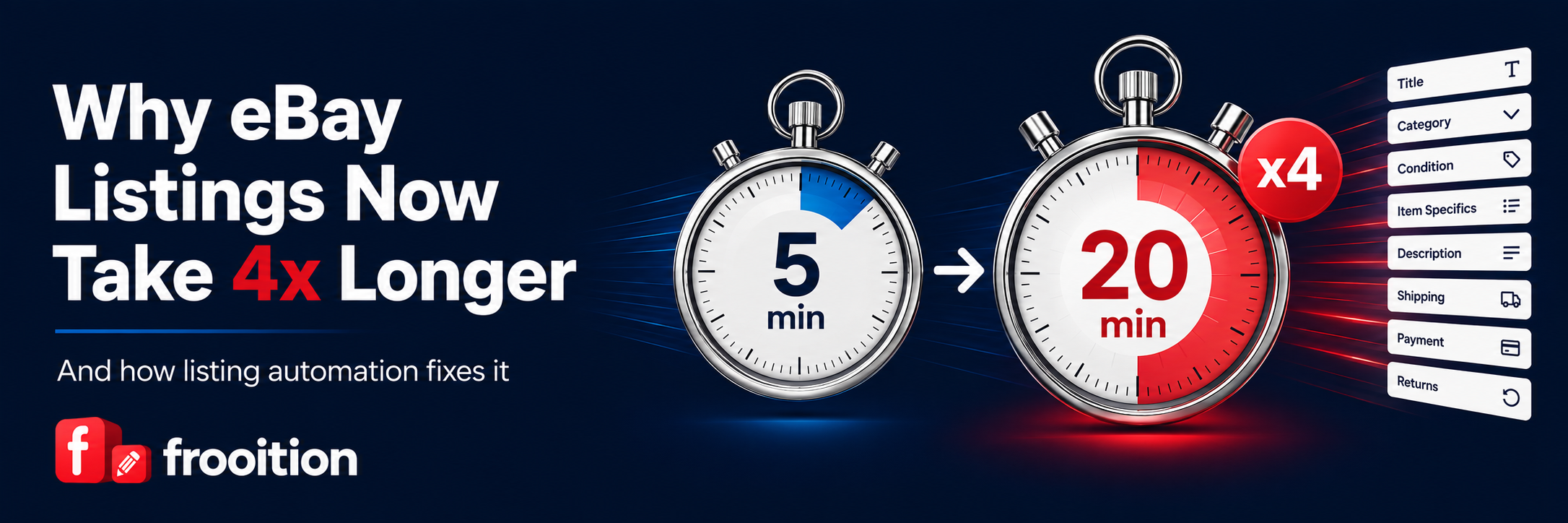
If you’re wondering whether eBay listing automation is worth it, the honest answer starts with how long listing actually takes now. Ask a professional eBay seller and the answer has changed. It used to be five minutes. Sellers now report three to four times that, and the reason isn’t a skills gap. It’s the form itself. Required item specifics keep expanding, and every Seller Hub redesign buries the fields one layer deeper than the last.
The box marked “later”
Picture a homeware seller sitting down with thirty new SKUs on a Sunday. Each one means finding the category, guessing which of the recommended item specifics actually matter, chasing a field that won’t validate, retyping the same brand and material thirty times, then rebuilding the description layout by hand. Four hours later, she’s done eleven. The other nineteen go into a box labelled “later.”
That box is the real inventory problem. Stock that’s paid for, photographed, and never listed doesn’t show up in any report — it just quietly caps how much of the business is actually visible on eBay. Multiply that across a full quarter and it’s not a backlog any more, it’s a meaningful share of paid-for inventory sitting in a stockroom instead of generating revenue.
This is a Seller Hub problem as much as a listing problem
The listing form isn’t the only thing that’s changed. Seller Hub’s own redesigns have removed summary totals, buried search and filters in nested sidebars, and pushed core actions further from view — changes independent reporting has tracked in detail as sellers adjust to each rollout. Each eBay Seller Hub redesign resets the muscle memory a seller had built up for the previous layout, adding a re-learning cost on top of the extra clicks.
Why item specifics keep expanding
eBay has steadily pushed more required and recommended item specifics fields into the listing flow, category by category, as part of a broader push toward structured, filterable data. That’s good for buyers, who get better filtering and more accurate search results. It’s a direct cost for sellers, who now have to supply more fields correctly before a listing will even publish — and get no shortcut for supplying the same brand, material, or size information across near-identical items.
None of this is something a seller can fix on their own
A seller can’t roll back a Seller Hub redesign or reduce the number of required item specifics eBay asks for. What they can control is how much of that repetitive work happens outside eBay’s own interface, where auto-fill item specifics and shared data entry can automate it instead of retyping.
What Frooition’s eBay Listing Automation Actually Changes
Frooition’s listing software pre-fills item specifics from your existing catalogue data, validates fields before eBay rejects them, and applies your design layout automatically instead of asking you to rebuild it by hand every time. This is item specifics automation in practice — brand, material, and shared specifics only need to be entered once and then reused, not retyped per listing. Thirty SKUs stops being a four-hour job and starts being closer to the five-minute one sellers remember.
If you also need to move a lot of items at once
If the bottleneck isn’t one listing at a time but hundreds sitting in a backlog, that’s a slightly different problem with its own fix — see our companion piece on listing multiple items and selling faster, which covers bulk upload specifically.
Common questions
Why does eBay keep adding more item specifics fields? Mostly to improve buyer-side search and filtering — more structured data means buyers can filter more precisely, which eBay treats as a search-quality investment even though it adds friction for sellers. With pre-filled item specifics carried over from your catalogue, that friction happens once instead of on every listing.
Does listing software actually save time, or just move the work around? Genuine time savings come from reuse — automated item specifics entered once and applied across every relevant listing, rather than retyped. Tools that just present the same fields in a nicer interface don’t solve the underlying problem.
Is this worth fixing for a small seller listing a handful of items a week? The time cost scales with volume, so the payoff is smaller at low volume — but even a handful of listings a week adds up over a year, and the setup cost of pre-filled item specifics is largely one-time.
What to do next
That’s the core job of good eBay listing automation — turning repeated data entry into a one-time setup. If Sunday afternoons are disappearing into item specifics, try it free on one item and see the difference before committing to anything.
Share This Blog Post
Related Posts




Thanks! We'll be in touch within one business day.