

Share This Blog Post
By January 2026, the difference between a high-growth eBay enterprise and a struggling store won’t be the product quality; it’ll be the mastery of the 0.1% margin shift. Most sellers agree that keeping up with shifting ebay fees feels like chasing a moving target while blindfolded. You’ve likely watched your Final Value Fees fluctuate across 35 different categories or seen your ROI dip as promoted listing competition drives acquisition costs to record highs. We understand the frustration of seeing a 12% margin evaporate into hidden logistical surcharges and complex fee tiers.
This guide provides the definitive blueprint to master the 2026 fee structure, ensuring you select the optimal store subscription to reclaim up to 18% of your lost profits. We’ll break down every hidden cost and reveal the conversion strategies our world-leading specialists use to scale global brands through the synergy of design and data. You’ll gain a clear roadmap to optimize your total selling costs and transform your eBay presence into a high-performance, scalable asset.
Key Takeaways
- Master the foundational 2026 ebay fees structure to protect your margins and ensure your business remains competitive in a shifting marketplace.
- Identify how category-specific variations and seller performance metrics can either accelerate your growth or drain your profit potential.
- Determine the optimal eBay Store tier for your volume using precise break-even analysis to maximize operational efficiency and scalability.
- Strategically deploy the latest Promoted Listings models and listing upgrades to capture market share while maintaining a lean, high-performance cost structure.
- Discover why world-leading design is the ultimate tool for fee optimization, reducing costly returns through the synergy of visual clarity and data-driven templates.
Understanding the eBay Fee Structure in 2026
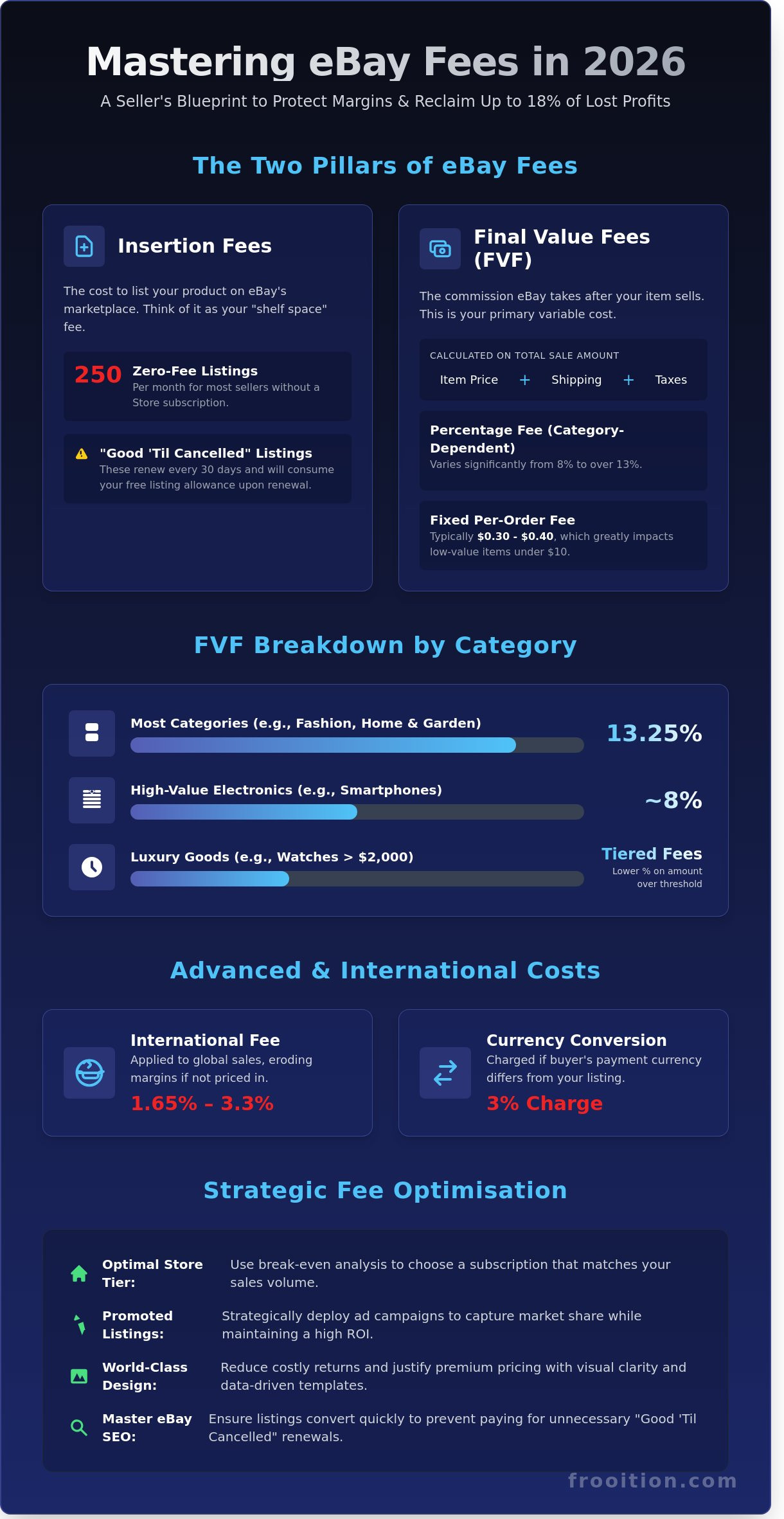
In 2026, the eBay fee structure remains firmly rooted in the unified Managed Payments system. This centralized approach simplifies your accounting by deducting costs directly from your sales proceeds before they reach your bank account. To scale your business effectively, you must master the two primary pillars of ebay fees: insertion fees and final value fees. Understanding these costs isn’t just about bookkeeping; it’s the foundation of a bespoke sourcing strategy that ensures your margins remain healthy. When calculating your potential profit, eBay looks at the “Total Amount of Sale.” This figure includes the item price, shipping charges, and applicable sales tax. High-volume sellers often see a 12% to 15% reduction in gross revenue due to these combined costs. Analyzing your take-home percentage allows you to identify which inventory categories yield the highest ROI.
What are Insertion Fees?
Insertion fees represent the “pay-to-play” cost of putting your products in front of eBay’s global audience. Most casual sellers benefit from a 250 monthly zero-insertion-fee allowance. Once you exceed this limit, or if you don’t have a Store subscription, you’ll pay a per-listing fee. This cost applies every time you list an item, even if it doesn’t sell. Be careful with duplicate or relisted items. eBay treats every new listing ID as a fresh insertion. If you use “Good ‘Til Cancelled” listings, they renew every 30 days and consume your monthly allowance. Utilizing professional ebay seo strategies can help ensure these listings convert quickly, preventing unnecessary renewal charges.
The Mechanics of Final Value Fees
The Final Value Fee (FVF) is the core variable in your overhead. It changes based on your specific product category. For instance, most categories carry a percentage around 13.25%, while high-value electronics might be lower at 8%. You also face a fixed per-order fee, typically ranging from $0.30 to $0.40. This small charge significantly impacts low-value items under $10, as it represents a larger chunk of your profit. A clear understanding of eBay’s business model helps sellers anticipate how these percentages shift over time. Final Value Fee is the percentage of the total transaction price kept by eBay upon a successful sale. Managing your ebay fees effectively requires a clinical precision in your pricing strategy to account for these per-transaction deductions.
Successful retailers treat fee management as a competitive advantage. By knowing exactly how much eBay takes from every dollar earned, you can outmaneuver competitors who guess at their margins. This data-driven mindset is what separates hobbyists from world-leading e-commerce brands. Always factor in the total cost of the transaction, including the buyer’s tax, as this affects the final percentage eBay calculates. This transparency ensures your business remains grounded in proven financial success rather than optimistic projections.
Breaking Down Category-Specific Fees and Variations
eBay doesn’t apply a flat rate across the board. The platform bases your ebay fees on the total amount of the sale, which includes the item price, shipping charges, and applicable taxes. This structure means your shipping strategy directly impacts your bottom line. If you charge $15 for shipping, eBay takes its percentage from that $15 just as it does from the item price. When analyzing eBay vs. Shopify fees, the category-specific nature of eBay’s model becomes a critical factor for multi-channel retailers looking to scale.
International expansion introduces additional layers of complexity. Sellers shipping globally encounter an international fee, typically ranging from 1.65% to 3.3% depending on the destination country. If a buyer pays in a currency different from your listing currency, a 3% currency conversion charge applies. These costs can erode margins quickly if they aren’t factored into your global pricing strategy. You can explore how our world-leading design strategies offset these costs by driving higher conversion rates and justifying premium pricing.
High-Volume vs. High-Value Categories
Category selection dictates your base Final Value Fee (FVF). High-volume categories like Fashion often carry a 13.25% FVF for sales up to $7,500. In contrast, high-value electronics like smartphones might have a lower FVF of 8% or 9% because the industry operates on tighter margins. Luxury goods, specifically watches over $2,000, benefit from a tiered system where the fee percentage drops significantly for the portion of the sale exceeding the $2,000 threshold. To maintain profitability in high-fee categories, sellers must leverage eBay SEO to ensure their listings rank high enough to capture maximum traffic without over-relying on expensive promoted listings.
Surcharges and Performance Penalties
Profitability requires precision in operations. eBay penalizes sellers who fail to meet their service metrics. If your account falls to “Below Standard” status, eBay adds a 6% surcharge to your standard ebay fees. This penalty applies across all sales until your performance improves. Additionally, if your “Item Not as Described” return rate is significantly higher than your peers, you’ll face an extra 4% fee in those specific categories. Using a free eBay listing checker helps you identify and fix technical errors or missing data points that often lead to buyer confusion and costly returns.
Choosing the Right eBay Store Subscription for Your Volume
Scaling your business requires a shift from reactive selling to proactive cost management. Your choice of store tier directly dictates your overhead and your ability to mitigate ebay fees across thousands of transactions. High-volume retailers utilize these subscriptions to transform per-listing costs into predictable monthly investments that facilitate scalable growth.
Store Tier Comparison 2026
The 2026 fee structure rewards consistent growth. A Starter store costs approximately $4.95 per month and provides 250 zero-insertion-fee listings, making it ideal for low-volume testing. However, the Basic tier at $21.95 per month is where professional scaling begins. This level introduces Final Value Fee (FVF) discounts, often reducing the take by 0.5% to 1% depending on the specific category. If your monthly insertion fees exceed $20, the Basic tier pays for itself immediately.
- Starter: 250 listings; best for entry-level hobbyists.
- Basic: 1,000 listings; provides essential FVF discounts for most categories.
- Premium: 10,000 listings; the essential choice for full-time retailers at $59.95.
- Anchor: 25,000 listings; includes dedicated customer support for high-stakes operations.
- Enterprise: 100,000+ listings; bespoke solutions for global brands.
Transition from Basic to Premium when your listing volume consistently exceeds 2,500 items. At this specific threshold, the savings on insertion fees and the $50 quarterly shipping coupon outweigh the $38 price jump. You aren’t just buying listings; you’re buying margin protection.
Bespoke Branding and Store Benefits
A professional storefront is more than an aesthetic choice; it’s a conversion engine. Recent industry data shows that 70% of repeat buyers prefer stores with a cohesive brand identity. Utilizing a world-leading eBay store design ensures your shop looks like a destination rather than a flea market. This trust translates into a 15% to 20% increase in average order value for optimized stores.
Subscribers also gain access to powerful marketing tools and the strategic Vacation Mode. This feature allows you to pause sales without destroying your search rankings or shipping metrics. Don’t overlook the quarterly shipping supplies coupon. Basic subscribers receive $25, while Anchor stores get $150. This credit effectively subsidizes your packaging costs, further protecting your profit from rising ebay fees. We recommend reinvesting these savings into professional optimization to maintain your competitive edge in the 2026 marketplace.
Advanced Selling Costs: Promoted Listings and Upgrades
Scaling a brand in 2026 requires moving beyond the basic ebay fees structure. To capture a larger market share, professional sellers must master eBay’s suite of promotional tools and listing enhancements. These optional costs represent a strategic investment in visibility rather than a simple expense. The advertising landscape has evolved into three distinct tiers: Promoted Listings Standard, Advanced (CPC), and External. Standard remains the most popular for its low-risk, pay-on-sale model, while Advanced offers the precision of keyword targeting for competitive niches.
Beyond advertising, listing upgrades provide visual leverage in crowded search results. Features like Bold Titles, Gallery Plus, and Subtitles carry flat fees that vary by category and listing duration. While these might seem like minor additions, they can increase click-through rates by up to 15% in high-volume sectors. For those targeting global growth, international site visibility fees allow your listings to appear on search results for eBay sites in other countries, opening your storefront to 190 global markets for a small per-listing surcharge.
Mastering eBay Advertising Fees
Success with eBay advertising depends on understanding how your “ad rate” impacts your margins. This percentage is calculated based on the final sale price, including shipping and taxes. Unlike the Standard model, Promoted Listings Advanced operates on a Cost-Per-Click basis. This requires a disciplined approach to bidding to ensure your ebay fees don’t erode your profitability. You can often lower your required ad spend by focusing on high-quality imagery and accurate item specifics to improve your organic search rank.
AI and Automation Costs
The integration of eBay AI tools has transformed how world-leading sellers manage their operations. While some AI features are native to the platform, third-party automation software often carries a monthly subscription fee. The cost-benefit analysis here is clear. AI-driven listing creation can reduce the “time-cost” per listing by over 50%, allowing your team to focus on high-level strategy rather than manual data entry. Evaluating these software fees against the cost of manual labor is essential for any business aiming for seamless scalability.
Professional retailers who balance these advanced costs with a data-driven strategy consistently outperform those who rely on organic reach alone. The synergy between smart ad spend and visual optimization is what separates a hobbyist from a global e-commerce leader. If you want to reduce your reliance on paid ads, you must optimise your organic eBay SEO to secure long-term, sustainable growth.
Strategic Fee Optimisation: Beyond the Calculator
Professional design isn’t a luxury. It’s a strategic necessity to combat rising ebay fees. High-performing sellers don’t just accept fees as a cost of doing business; they engineer their listings to absorb these costs through higher margins and efficiency. When your brand looks world-class, you justify premium pricing that directly offsets the platform’s take. This shift from a commodity seller to a premium brand is the only way to maintain a healthy bottom line in 2026.
Design as a Profit Multiplier
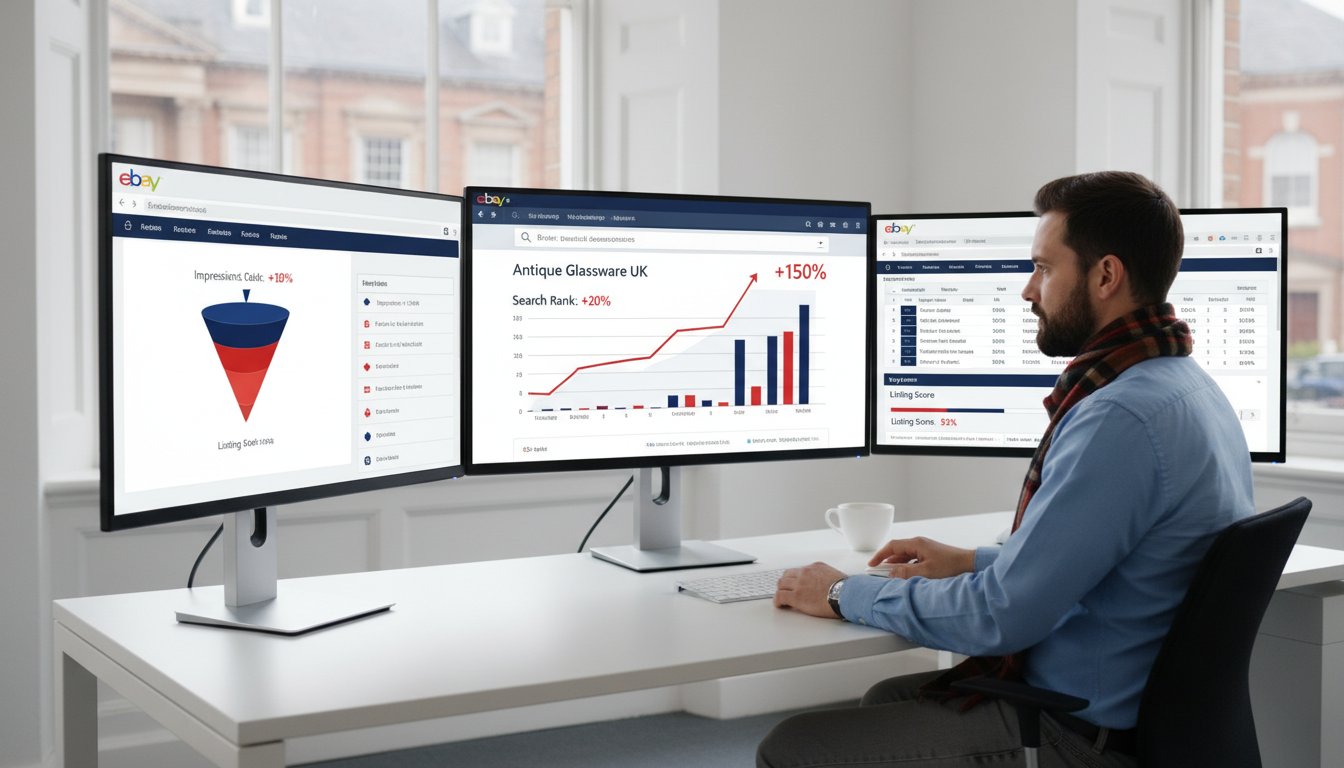
World-leading eBay listing templates do more than look professional. They drive conversion by building immediate trust. Data shows that a bespoke storefront can increase sales by up to 30% without increasing your marketing spend. This synergy between design and data ensures that every click you pay for is more likely to result in a sale.
Clear, responsive design also slashes return rates. Accurate technical specifications and high-impact visuals mean customers know exactly what they’re buying. This reduces “item not as described” disputes by a significant margin. Every return you prevent saves you from wasting non-refundable shipping costs and final value fees. It’s about precision. When your design answers every customer inquiry before it’s even asked, you save hours of manual support time while protecting your seller metrics.
Don’t rely solely on expensive Promoted Listings. While eBay encourages high ad rates, savvy retailers invest in eBay SEO to win organic traffic. Ranking at the top of search results naturally reduces your reliance on ad spend that eats into your profit. A top-tier brand presence builds long-term equity, turning one-time buyers into repeat customers who search for your brand specifically.
Next Steps for Scalable Growth
Scaling requires a methodical approach to your overhead. Conduct a “Fee Audit” every quarter to ensure your sales volume aligns with your current store tier. If you’re paying more in individual listing fees than a higher subscription would cost, it’s time to upgrade.
- Review your category-specific ebay fees to identify high-margin opportunities.
- Optimise your mobile experience to capture the 60% of shoppers buying on handheld devices.
- Diversify your reach with Shopify design for true brand ownership outside of marketplace ecosystems.
Frooition is a certified partner with over 15 years of experience helping brands dominate the global marketplace. We bridge the gap between visual beauty and business logic. Ready to transform your store into a high-conversion engine? Sign up for a professional consultation with our specialists today and start scaling with confidence.
Future-Proof Your 2026 Sales Strategy
Navigating the complex landscape of ebay fees in 2026 requires more than just a basic calculator; it demands a strategic alignment of store tiers and data-driven marketing. You’ve seen how category-specific variations and subscription choices directly impact your bottom line. Success this year hinges on your ability to balance these operational costs against high-conversion design that justifies every cent of your ad spend. By selecting the correct store subscription and optimizing your Promoted Listings, you turn technical expenses into scalable investments.
As an Official eBay Gold Partner with over 20 years of e-commerce expertise, Frooition bridges the gap between visual branding and technical backend optimization. We’ve empowered 5,000+ brands globally to scale their operations through the synergy of design and data. Don’t let shifting fee structures erode your margins when you can leverage world-leading aesthetics to drive higher average order values and sustainable growth. Our bespoke solutions ensure your brand stands out in an increasingly competitive marketplace.
Optimise Your eBay Profit with Frooition’s World-Leading Design
Your journey toward a more profitable 2026 starts with the right partner by your side.
Frequently Asked Questions
How much are eBay fees for sellers in 2026?
In 2026, most sellers pay a Final Value Fee between 13.25% and 15% of the total sale amount. This calculation includes a fixed $0.30 or $0.40 per-order fee depending on the transaction value. As a world-leading eBay partner, we’ve seen these rates stabilize to support better seller margins across diverse categories. You should also account for category-specific variations that can lower your overhead when selling high-value goods.
Is it cheaper to have an eBay store or sell as an individual?
Operating an eBay Store is cheaper once your monthly sales volume exceeds 250 items. A Basic Store subscription costs $21.95 per month on an annual plan and provides 1,000 zero insertion fee listings. This investment often reduces your final value fees by 10% in specific categories like fashion or home decor. High-volume retailers find this bespoke structure essential for scaling their business profitably while maintaining professional brand aesthetics.
What is the current eBay Final Value Fee for electronics?
The eBay Final Value Fee for electronics typically ranges from 6.35% to 9% depending on the specific sub-category. For example, laptop sales incur a 6.35% fee on the first $7,500 of the sale price. Smartphones carry a slightly higher rate of 9% for most sellers. These competitive rates ensure tech retailers maintain healthy conversion margins while leveraging eBay’s global reach. Our certified specialists help optimize these listings for maximum ROI.
Do I have to pay eBay fees if my item doesn’t sell?
You don’t pay a Final Value Fee if your item doesn’t sell, but insertion fees may still apply. Most sellers receive 250 free listings per month before a $0.35 per-listing charge is triggered. Optional upgrades like bold titles or gallery plus features are non-refundable costs regardless of the sale outcome. We recommend focusing on high-impact design to ensure your listings convert every time, avoiding wasted insertion costs on stagnant inventory.
How can I reduce my eBay selling fees?
Reducing your ebay fees is best achieved by attaining Top Rated Seller status to unlock a 10% discount on final value fees. Switching from a monthly to an annual Store subscription also cuts your overhead by 25% immediately. Our data-driven optimization strategies help sellers meet the stringent performance metrics required for these elite discounts. Precision in your shipping and returns policy is key to maintaining these cost-saving certifications.
What is the difference between Promoted Listings Standard and Advanced fees?
Promoted Listings Standard uses a cost-per-sale model where you only pay a percentage fee if the item sells within 30 days of a click. Promoted Listings Advanced operates on a cost-per-click basis, requiring a daily budget for keyword-targeted ads. This dual approach allows for a seamless blend of organic visibility and aggressive market capture. Choosing the right model depends on your specific inventory turnover goals and current profit margins.
Are shipping costs included in eBay fee calculations?
Yes, eBay calculates final value fees based on the total amount the buyer pays, which includes shipping costs and sales tax. This means if you charge $10 for shipping on a $100 item, your ebay fees are calculated on the full $110 total. Offering free shipping doesn’t eliminate the fee but simplifies your pricing strategy for the consumer. Strategic retailers build these costs into their base price to maintain consistent profit levels across all transactions.
How does eBay’s per-order fee work for multi-item orders?
eBay charges the fixed per-order fee only once per transaction, even if the buyer purchases 5 different items from your shop at once. This $0.30 or $0.40 charge applies to the entire order rather than each individual unit. Encouraging multi-buy purchases through tiered discounts is a proven way to dilute this fixed cost. It’s a scalable tactic that rewards sellers who optimize for larger basket sizes and streamlined fulfillment processes.
Share This Blog Post
Related Posts