


Share This Blog Post
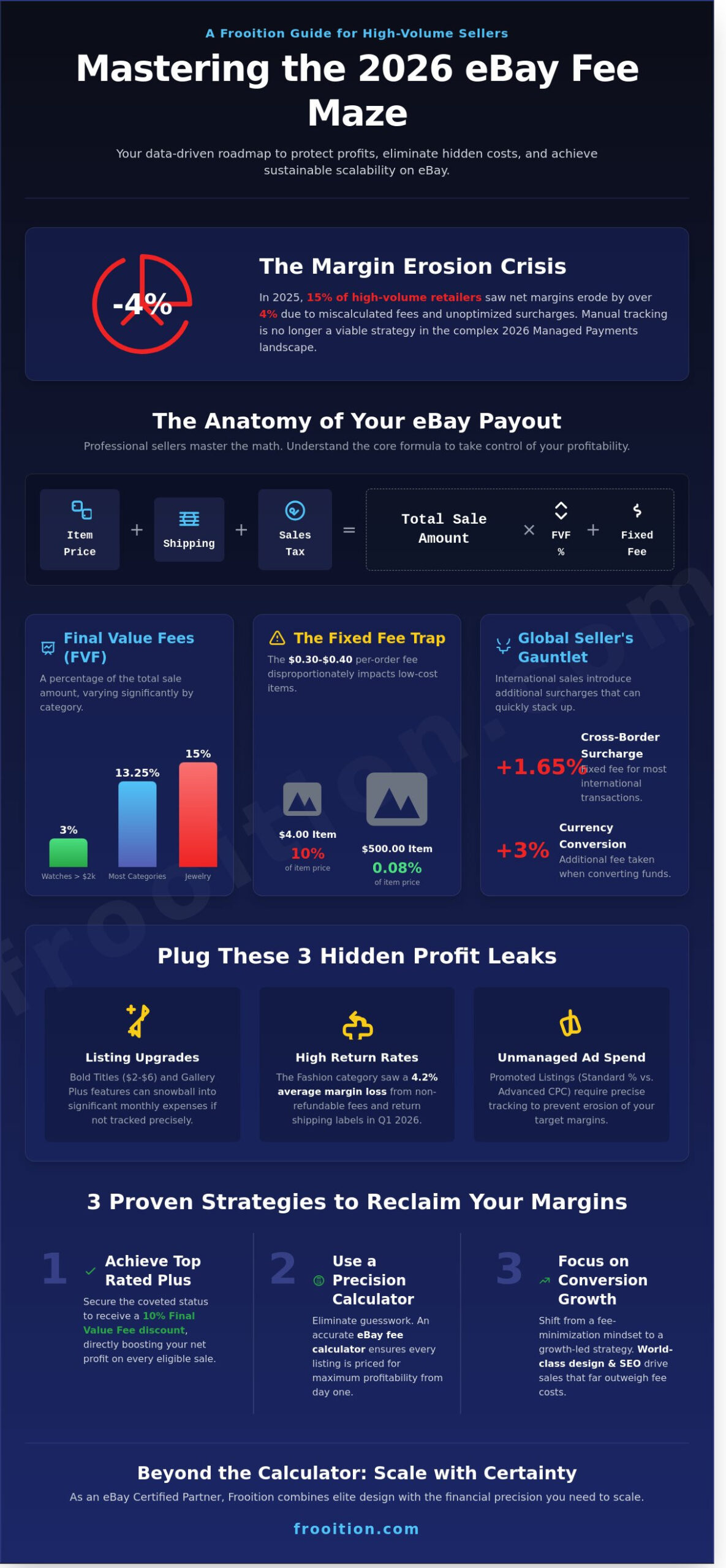
Did you know that in 2025, an estimated 15% of high-volume retailers saw their net margins erode by more than 4% due to miscalculated final value fees and unoptimized shipping surcharges? For the ambitious seller, a single overlooked international fee can transform a high-end conversion into a break-even burden. You’ve likely spent hours agonizing over spreadsheets, trying to predict exactly what will land in your bank account after the hammers fall. It’s a common pain point for even the most seasoned retailers who are scaling their operations on a global level.
As a world-leading eBay Certified Partner, we understand that your success relies on the synergy between elite design and clinical financial precision. This guide will master the complexities of the 2026 fee structure, teaching you how to use an ebay fee calculator to protect your bottom line with absolute accuracy. We’ll provide a bespoke framework for pricing your inventory and reveal three proven strategies to lower the impact of hidden costs. By the end of this article, you’ll have a clear, data-driven roadmap to maximize your scalability and ensure every listing is optimized for peak profitability.
Key Takeaways
- Understand why manual fee calculations are no longer viable for high-volume retailers in the complex 2026 Managed Payments landscape.
- Master the core formula for profit protection by utilizing a precision ebay fee calculator to account for category percentages, taxes, and fixed order costs.
- Discover actionable strategies to reclaim your margins, including how to secure the 10% Final Value Fee discount through Top Rated Plus status.
- Learn why world-leading sellers shift their focus from fee percentages to conversion-led growth to achieve sustainable business scalability.
Understanding the 2026 eBay Fee Landscape: Why You Need a Calculator
Professional selling in 2026 demands more than just high volume; it requires surgical precision in margin management. The marketplace has evolved into a complex ecosystem where a 1% shift in overhead can dictate the difference between a scaling enterprise and a stagnant storefront. Relying on mental math or outdated spreadsheets is a recipe for failure. Using a dedicated ebay fee calculator is the only way to ensure your pricing strategy accounts for the multifaceted cost structures that define the current era of e-commerce.
The psychological trap of focusing on gross sales figures often leads high-volume retailers into a “growth at any cost” mindset. While a $500,000 monthly turnover looks impressive on a dashboard, the reality of net profit is often obscured by tiered fee structures and variable ad spend. By January 2026, eBay’s category-specific fee adjustments created a polarized environment. Sellers in high-demand sectors like Refurbished Electronics saw fee incentives, while those in saturated lifestyle categories faced a 0.5% increase in base rates. Without real-time calculation, these incremental changes silently erode your bottom line.
The Shift to Managed Payments in 2026
The consolidation of financial operations under eBay Managed Payments has streamlined the checkout process, yet it has also centralized the fee burden. Final Value Fees are the primary cost of doing business on eBay, calculated as a percentage of the total amount of the sale, including shipping and taxes. This all-in-one model replaced the fragmented PayPal era, but it introduced new variables for global retailers. For instance, international payment surcharges now sit at a fixed 1.65% for most cross-border transactions, while currency conversion fees can take an additional 3% bite out of your revenue. Frooition’s world-leading approach to ebay SEO ensures that while you manage these costs, your visibility remains optimized for maximum conversion.
The Hidden Costs of Selling on Marketplaces
Profit leaks often occur in the “optional” extras that sellers overlook during the listing process. Listing upgrades such as Bold Titles ($2.00 to $6.00 per listing) or Gallery Plus features can quickly snowball into significant monthly expenses if not tracked. Furthermore, the 2026 returns policy impact cannot be ignored. Data from the first quarter of the year shows that high return rates in the Fashion category resulted in an average 4.2% margin loss due to non-refundable per-order fees and shipping labels. International sellers face even steeper hurdles, as they must balance local VAT requirements with eBay’s complex regional fee tiers. Success requires a synergy between design and data, ensuring every listing is as cost-effective as it is beautiful.
How the eBay Fee Calculator Works: Breaking Down the Math
Professional sellers don’t guess their margins. They master the arithmetic of the marketplace. To get the most out of an ebay fee calculator, you have to understand the core formula that governs your payouts. eBay calculates fees based on the total amount of the sale, which follows this logic: (Sold Price + Shipping Charged to Buyer + Sales Tax) x Category Percentage + Fixed Per-Order Fee.
This total amount approach is where many retailers lose track of their actual take-home pay. Since sales tax varies by the buyer’s location, your fee on an identical item can fluctuate depending on whether it’s shipped to New York or Oregon. Beyond the base formula, you must input variables like your Cost of Goods Sold (COGS), shipping supplies, and any Promoted Listings fees. Standard Promoted Listings are a percentage of the final sale, while Advanced ads use a Cost-Per-Click (CPC) model. Both require precise tracking to prevent them from eroding your 20% or 30% target margins.
Final Value Fees (FVF) Explained
The Final Value Fee is the primary engine of eBay’s revenue model. For most categories, including Electronics and Home, the rate sits at 13.25% for the first $7,500 of the sale. Specialized categories like Watches over $2,000 may see lower rates around 3%, while Jewelry often hits 15%. You can’t ignore the fixed per-order fee of $0.30 to $0.40. While it’s negligible on a $500 item, it represents a massive 10% hit on a $4 item. High-volume sellers moving low-cost inventory must use an ebay fee calculator to optimize their pricing and absorb this fixed cost without sacrificing scalability.
Insertion Fees and Store Subscriptions
Your store subscription level acts as a multiplier for your efficiency. A Basic Store costs $21.95 monthly and provides 1,000 fixed-price listings. If your inventory grows to 2,500 items, the $0.35 insertion fee for those extra 1,500 listings would cost you $525. Upgrading to a Premium Store at $59.95 monthly grants you 10,000 listings, instantly saving you $465 in fees. The break-even point for a Premium Store usually occurs once you consistently list more than 1,100 items. Combining this cost-saving structure with a certified eBay SEO strategy ensures that your increased listing volume translates into actual market dominance and higher conversion rates.
Manual Calculation vs. Automated Tools: Which is Better?
Growth in the 2026 e-commerce landscape demands clinical precision. Relying on a manual spreadsheet built during the Spring 2024 Seller Update is a recipe for margin erosion. Professional retailers now treat the ebay fee calculator as a core component of their procurement engine rather than a post-sale audit tool. Manual data entry carries a 1% to 3% error rate in complex multi-item orders, which can instantly wipe out the gains from a high-volume promotion. When you’re managing thousands of transactions, those small discrepancies compound into significant annual losses.
Professional sellers use automated tools to batch-process profit estimates because speed is a competitive advantage. These tools allow you to integrate fee calculation directly into your sourcing and procurement strategy. Instead of guessing your net return, you can model the exact impact of eBay’s latest fee structures before you even cut a purchase order for new stock. This proactive approach ensures your business remains agile and profitable regardless of marketplace volatility.
The Pros and Cons of Manual Spreadsheets
Manual spreadsheets offer bespoke control over niche variables, yet they often fail to account for the “small print” in eBay’s seasonal releases. A spreadsheet built in January 2025 won’t capture the subtle changes in category-specific final value fees or the updated international shipping surcharges introduced in late 2025. This method is best for micro-sellers with under 50 SKUs who have the luxury of time to audit every line item. For scaling brands, the time-sink of manual entry represents a high opportunity cost that distracts from core optimization tasks.
Why Automated Calculators Win for Scaling Brands
Scaling brands require instant “what-if” scenarios to test price elasticity across different regions. Modern automated tools integrate regional tax variations and the latest 2026 shipping surcharges automatically. They protect your time by batch-processing thousands of profit estimates in seconds. High-volume sellers use an ebay fee calculator to ensure that a 5% shift in shipping costs doesn’t turn a profitable product into a liability. This synergy between data and strategy is what separates world-leading retailers from the competition. Using automated systems allows you to maintain a “design that sells” philosophy while keeping your backend financials perfectly balanced.
- Automated tools update in real-time to reflect the latest 2026 fee structures.
- Manual entry increases the risk of human error by 2.5% on average in multi-item orders.
- Sourcing integration allows you to calculate net margins before committing to inventory.
- Scalability is only possible when you remove the bottleneck of manual data processing.
It’s clear that while manual sheets provide a sense of control, they don’t offer the reliability required for an enterprise-level operation. Successful sellers trust certified partners and professional-grade tools to handle the heavy lifting of data analysis, ensuring every listing is optimized for both conversion and maximum profit.
Strategies to Offset eBay Fees and Protect Your Margins
Relying solely on an ebay fee calculator to track your costs is a reactive approach. To dominate the marketplace in 2026, you must implement proactive strategies that neutralize these expenses before they erode your bottom line. Professional sellers focus on two primary levers: maximizing eBay’s internal incentives and optimizing the internal efficiency of their operations. Achieving Top Rated Plus status is the most direct route to fee reduction, offering a 10% discount on Final Value Fees. For a seller moving $100,000 in monthly volume, this status keeps an additional $1,200 to $1,500 in their pocket every single month.
Your shipping strategy also requires clinical precision. Because eBay applies fees to the total transaction amount, including shipping and handling, any bloat in your fulfillment costs increases your fee burden. Many world-leading brands now utilize “Free Shipping” models to boost conversion rates while simultaneously simplifying their fee structure. By consolidating shipping costs into the item price, you improve your search standing and eliminate the “fee on a fee” scenario that occurs with high-cost freight. To further protect margins, smart retailers are integrating eBay AI tools to automate listing creation. This technology reduces the labor cost per listing by approximately 35%, allowing your team to scale inventory without a linear increase in payroll expenses.
- Increase Average Order Value (AOV): Higher price points dilute the impact of fixed per-order fees.
- Inventory Turn Rate: Faster sales cycles reduce the long-term storage and opportunity costs associated with stagnant stock.
- Bespoke Branding: Professional design justifies premium pricing, moving your business away from “race to the bottom” price wars.
The Power of eBay SEO and Visibility
Organic visibility is the most effective way to bypass expensive ad fees. When your products rank naturally on the first page, your reliance on Promoted Listings Standard and Advanced drops significantly. Currently, many sellers spend between 7% and 12% of their revenue on advertising just to maintain baseline visibility. A professional eBay SEO audit identifies the data gaps in your item specifics and titles that are costing you sales. By aligning your data with eBay’s Cassini search engine, you create a seamless path for buyers, lowering your customer acquisition costs by up to 22%.
Reducing Returns Through Better Listing Templates
Returns represent a massive, often hidden, cost in your ebay fee calculator projections. The total cost of a return often exceeds 1.5 times the original shipping cost when you account for inspection and restocking labor. High-quality, Frooition’s eBay listing templates provide the clarity and trust needed to set accurate buyer expectations. Clear technical specifications and professional imagery reduce “item not as described” claims by as much as 30%. This transparency protects your Top Rated status and ensures your margins remain intact by preventing the logistical nightmare of reverse commerce.
Ready to maximize your profitability and outpace the competition? Get a professional eBay SEO audit today to lower your ad spend and boost organic sales.
Beyond the Calculator: Scaling Your eBay Business with Frooition
Understanding your numbers through an ebay fee calculator is the baseline for survival, but it isn’t the ceiling for your success. Top-tier retailers understand that while fees are a fixed reality, conversion rates are a variable you can control. By shifting your focus from “how much can I save on fees” to “how much more can I earn per click,” you transform your entire business model. This is the Frooition Effect. Our world-leading design strategies allow sellers to justify price points 10% to 15% higher than their competitors by building immediate trust. When your store looks like a global brand, buyers stop price-shopping and start buying into your reliability. Professional sellers don’t compete on price; they compete on presentation and perceived value.
The ROI of Professional Store Design
Data shows that a cohesive, bespoke storefront can increase customer loyalty and repeat purchase rates by up to 25% compared to standard templates. A professional identity signals that you aren’t just a hobbyist; you’re a certified specialist. You should check your current listings with our free eBay listing checker to identify gaps in your mobile optimization or active content. Unlike recurring subscription fees that eat into your margins, a custom design is a one-time investment. It pays dividends on every single transaction by lowering your customer acquisition costs over the long term. We’ve seen sellers transition from small-scale operations to multi-million dollar enterprises simply by aligning their visual brand with the quality of their products.
Leveraging AI for Future Growth
Scaling rapidly in 2026 requires more than just manual effort. Our eBay AI listing tool helps sellers launch hundreds of optimized listings in a fraction of the time it took in 2024. AI reduces the “soft costs” of your business, such as the hours spent on copywriting, image cleaning, and category mapping. These hidden expenses often go uncounted by a basic ebay fee calculator, yet they are the biggest drain on your scalability. This efficiency allows you to focus on high-level strategy rather than data entry. Audit your current store today for fee-saving opportunities by looking at your listing quality and category accuracy. If you’re ready to move beyond basic calculations and build a scalable empire, book a consultation with our eBay experts today.
Master Your Margins and Scale Your eBay Empire
Navigating the 2026 marketplace requires more than just intuition; it demands absolute mathematical certainty. You’ve seen how a precise ebay fee calculator acts as your first line of defense against margin erosion. By distinguishing between manual oversight and automated precision, you can maintain profit thresholds above the 25% industry benchmark. Protecting your bottom line is the foundation, but scaling requires a world-leading partner who understands the intersection of data and design.
Frooition provides that elite edge. As an Official eBay Gold Partner with over 20 years of e-commerce expertise, we’ve empowered 5,000+ brands globally to outpace their competition. We don’t just build stores; we create high-conversion environments where professional aesthetics meet technical optimization. Our team uses a results-oriented approach to ensure your brand identity reflects your status as a top-tier retailer. It’s time to move beyond the spreadsheet and start building a legacy that lasts. You’ve got the tools to succeed, and the right strategy will make your growth inevitable.
Maximize your eBay profits with a bespoke store design from Frooition
Frequently Asked Questions
How much does eBay take per sale in 2026?
eBay typically retains 13.25% of the total sale price plus a $0.30 fixed fee per order for most standard categories. This percentage fluctuates depending on your specific niche; for instance, Books and Media often incur a 14.95% fee. Professional retailers must account for these variations to ensure their bespoke pricing strategies remain competitive. High-volume sellers utilize these precise figures to maintain scalable growth and predictable profit margins across their entire inventory.
Does the eBay fee calculator include shipping costs?
A comprehensive ebay fee calculator must include shipping costs because eBay charges fees on the total amount the buyer pays. This total includes the item price, shipping service charges, and any applicable sales tax. If you charge $20 for shipping on a $100 item, eBay calculates the final value fee on the full $120. Our data-driven approach ensures your margins remain protected against these variable overhead costs during every transaction.
What is the difference between a listing fee and a final value fee?
A listing fee is a non-refundable $0.35 charge paid upfront to post an item, whereas a final value fee is only charged after a successful sale. Most sellers receive 250 zero insertion fee credits per month to minimize initial overhead. Once those credits are exhausted, the $0.35 fee applies regardless of whether the item sells. Final value fees represent the bulk of your costs, typically ranging from 12% to 15%.
Are eBay fees different for Top Rated Sellers?
Top Rated Sellers receive a 10% discount on final value fees when they meet specific Top Rated Plus listing requirements. You must offer a 30 day money back return policy and provide 1 day handling to qualify for this incentive. This discount significantly boosts your bottom line on high-volume inventory. It’s a hallmark of world-leading sellers who prioritize operational excellence and customer satisfaction to maximize their global reach and profitability.
How do I calculate profit if I use eBay Promoted Listings?
To calculate profit with Promoted Listings, you subtract the specific ad rate percentage you’ve set from the total transaction amount. If you set a 7% ad rate on a $200 sale, you’ll pay $14 in addition to your standard final value fees. This marketing spend is a critical lever for driving conversion in crowded categories. Our certified experts recommend balancing this investment against your organic reach to optimize your total return on ad spend.
Does eBay charge fees on the sales tax collected from the buyer?
eBay applies final value fees to the total amount paid by the buyer, which includes the sales tax collected by the platform. If a buyer in California pays 9.5% sales tax on a purchase, your fee is calculated on that higher gross total. This policy remains a standard part of eBay’s managed payments system in 2026. Sellers should factor this roughly 0.5% to 1% effective fee increase into their global pricing models.
Can I reduce my eBay fees by opening a store?
Opening an eBay Store reduces your final value fees by approximately 1% in most categories while providing more free listings. A Basic Store subscription costs $21.95 per month and lowers the standard 13.25% fee to 12.35% for many items. This transition is a strategic move for businesses generating over $2,500 in monthly sales. It transforms your presence from a casual seller into a professional, world-leading brand with better long-term scalability.
What happens to my fees if a buyer returns an item?
eBay credits the variable final value fee back to your account if a buyer returns an item and you issue a full refund. However, the platform generally keeps the $0.30 fixed per-order fee as an administrative cost. You must process the refund through the official eBay returns flow to trigger this credit automatically. Managing these instances with precision is vital for maintaining the healthy cash flow required for sustained e-commerce success in competitive markets.
Share This Blog Post
Related Posts