
Share This Blog Post
Shopify’s own theme store is stocked with polished, professional options — but professional isn’t the same as distinctive. Most premium themes are built to work for thousands of different stores at once, which means the safest, most universal choices end up looking remarkably similar once installed. You’ve likely felt the sting of technical limitations when trying to push a standard theme beyond its intended purpose. It’s frustrating when your webstore feels like a generic placeholder that doesn’t reflect the authority you’ve established on eBay or Amazon. Investing in Shopify custom theme development moves you past that ceiling — building a storefront around your brand’s actual requirements rather than a template’s defaults.
We understand that your storefront must do more than just look pretty. It needs to convert. This guide reveals how bespoke Shopify development moves beyond basic templates to create a high-conversion, cross-channel brand experience. You’ll discover the synergy between world-class UX and backend technical optimization. We’ll show you how our status as a certified partner helps you bridge the gap between marketplace channels and your flagship store for a seamless, unified identity.
Key Takeaways
- Learn why moving beyond restrictive templates to bespoke Liquid development gives growing brands room their theme can’t provide.
- Understand how Shopify custom theme development optimizes page speed and creates unique product discovery journeys that standard themes can’t replicate.
- See how to weigh a custom build against a premium theme based on your actual catalogue size and growth plans, not a one-size-fits-all revenue threshold.
- Master the roadmap from performance auditing to UX/UI wireframing to ensure your storefront is built on data-driven business logic.
- Explore how certified expertise bridges the gap between Shopify growth and marketplace success through a “design that sells” philosophy.
Beyond Templates: Why Shopify Custom Theme Development Is the Standard for 2026 Brands
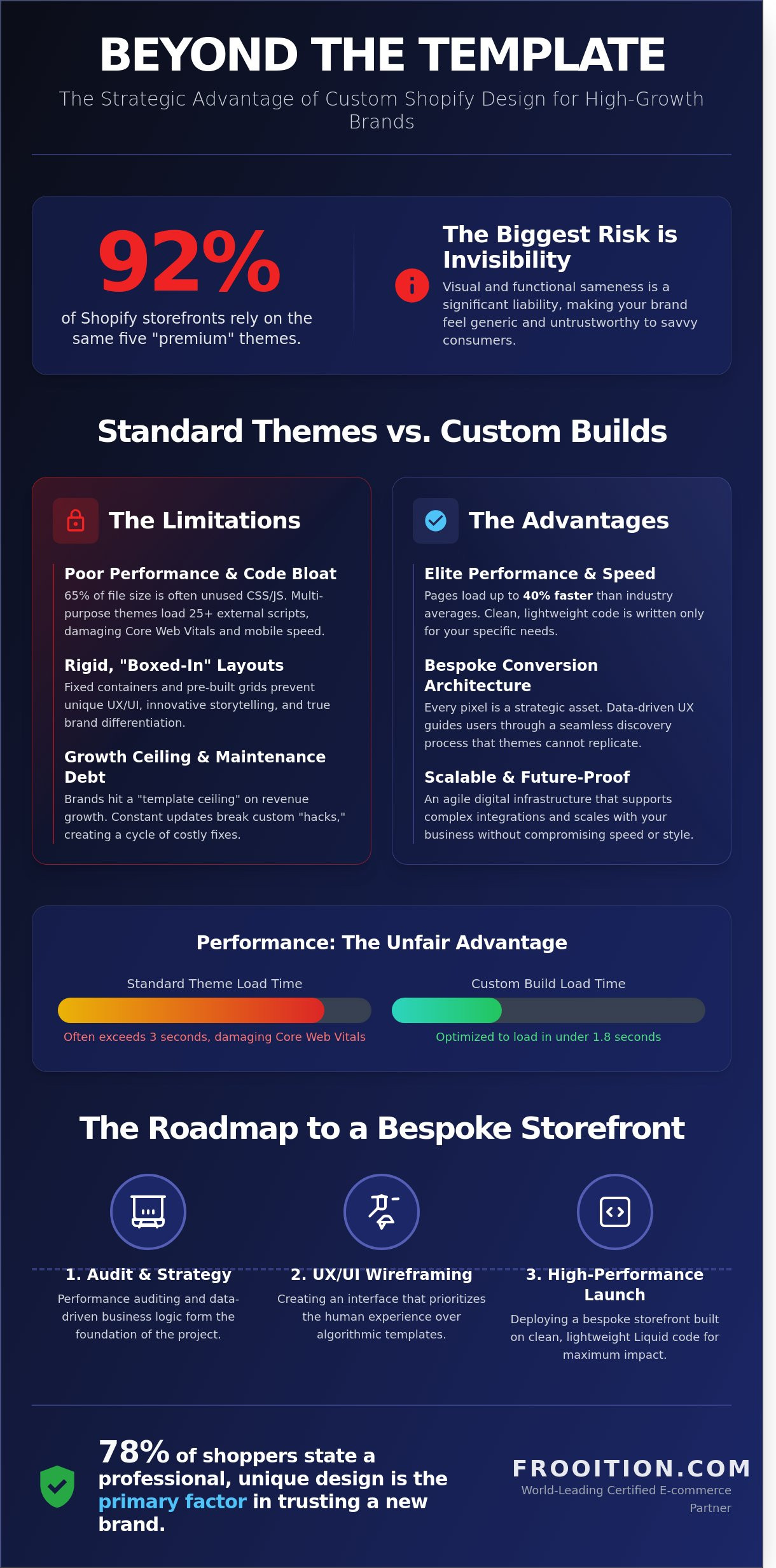
High-growth retailers no longer settle for the limitations of pre-packaged themes. True Shopify custom theme development isn’t a simple configuration of colors and fonts; it’s the architectural development of a storefront using bespoke Liquid code. As the Shopify platform has grown to serve millions of merchants, visual and functional sameness has become a real liability for brands trying to stand out. Fast-growing retailers often hit a “template ceiling” where rigid layouts prevent them from scaling their unique value propositions. To break through, that means prioritizing lightweight, purpose-built code over the dependencies of heavy, generic third-party apps.
The shift toward bespoke development is driven by the need for genuine conversion architecture — treating every page element as a strategic asset rather than a default. Many of today’s most effective e-commerce stores have moved away from generic drag-and-drop builders in favor of clean, optimized environments built specifically around how their customers actually shop.
The Limitations of Off-the-Shelf Shopify Themes
Standard themes are built to serve as many different stores as possible, which inevitably means carrying code and features most individual stores never use. That excess weight can drag down Core Web Vitals, particularly Largest Contentful Paint (LCP) scores. Achieving a genuinely unique UX/UI within a pre-built grid is a constant struggle against the “boxed-in” look that savvy consumers increasingly recognise. While a free or low-cost theme looks cost-effective upfront, the ongoing cost of hiring developers to patch functionality gaps can add up to more than the investment of Shopify custom theme development from the start.
- Code Inefficiency: Multi-purpose themes typically load more external scripts than a single-purpose store needs, which can slow mobile performance.
- Rigid Layouts: Fixed containers prevent the deployment of innovative storytelling elements.
- Maintenance Debt: Theme updates can break custom “hacks” used to bypass built-in theme limits.
The Strategic Value of Brand Differentiation
Standing out matters more as AI-generated and templated storefronts become more common. A professional, distinctive design signals to a visitor that they’re dealing with an established specialist rather than a generic reseller — first impressions carry real weight in a buyer’s decision to trust a new brand. Our certified partner status allows us to build interfaces that prioritize the human experience over algorithmic templates.
By choosing bespoke Shopify design, retailers gain total control over their brand narrative. This strategic autonomy ensures that as your business scales, your digital infrastructure remains agile and capable of supporting complex integrations without compromising speed or style.
The Architecture of Conversion: Technical Advantages of Bespoke Shopify Development
Off-the-shelf themes are built to serve thousands; Shopify custom theme development is built to serve only your customers. Technical agility is a real differentiator between market leaders and stagnant brands. Custom Liquid development allows our engineers to strip away the feature bloat found in pre-made templates, focused specifically on what your store actually needs.
High-end design achieves its full potential when it’s synchronized with backend data — mapping out intuitive categorization and visual hierarchy so your site architecture mirrors the way your specific audience shops. This data-driven approach removes friction and guides users through a seamless discovery process that generic themes can’t replicate. With the majority of e-commerce traffic now coming from mobile devices, a bespoke mobile-first UX isn’t optional — it’s foundational.
Optimizing the User Journey with Custom UI
Generic navigation menus often fail complex product catalogues. We build bespoke filtering systems that help customers find what they need quickly. Small details — micro-interactions that provide instant feedback during the shopping process — add polish that off-the-shelf themes rarely get right. Integrating custom cart drawers and intelligent upsell modules directly into the storefront supports a smoother path to purchase without disrupting the user flow. Explore how bespoke Shopify design can transform your storefront’s performance.
Performance and Core Web Vitals
Google’s Core Web Vitals remain a key factor in search visibility. Custom builds eliminate the heavy CSS and JavaScript libraries that generic themes rely on to cover every possible use case. By coding features natively rather than bolting on third-party apps, sites can run leaner — which tends to mean fewer security vulnerabilities and lower monthly overhead. Faster sites don’t just rank better; they tend to convert better too, since a slow storefront costs sales before a visitor ever reaches checkout.
Evaluating Your Options: Custom Builds vs. Premium Themes vs. AI-Generated Stores
Choosing your store architecture is one of the more consequential decisions you’ll make this year. AI-generated stores promise a fast launch, but they often deliver a shallow, generic experience that struggles to convert at scale — buyers increasingly recognise cookie-cutter layouts, and that recognition can undercut trust before they’ve read a single product description. Premium themes offer a solid middle ground for many stores, but for retailers with complex catalogues or ambitious growth plans, Shopify custom theme development becomes the only way to sustain that growth without hitting a technical ceiling. Custom builds require a higher initial investment and a longer development timeline, but they offer scalability that off-the-shelf templates simply can’t match. For brands considering alternative platforms, exploring BigCommerce website design strategies can provide valuable insights into cross-platform optimization approaches. It’s also worth understanding the complete BigCommerce vs Shopify comparison before committing to a platform for the long term.
When a Premium Theme Is Enough
Retailers in the startup phase often prioritize speed over total control, and that’s a reasonable trade-off early on. Shopify’s Theme 2.0 architecture provides real flexibility for launching and testing product-market fit without a custom build. Even high-performing themes eventually reach a technical ceiling, though — at that point, many brands choose to work with a certified partner to extend their existing theme with bespoke sections rather than starting from scratch, which can meaningfully extend the theme’s useful life before a full custom migration is worth considering.
The ROI Case for Custom Shopify Design
Even a modest improvement in conversion rate compounds meaningfully over a year of trading — the exact return depends heavily on your traffic volume, average order value, and starting conversion rate, so it’s worth working through the numbers for your specific store rather than relying on a generic industry figure. Custom builds reduce the “app bloat” that slows down standard themes, which can lower both your customer acquisition costs and your ongoing app subscription spend. When you control every pixel, you can weave brand storytelling into the checkout flow itself, which supports higher average order value over time. Reach out for a transparent breakdown of what Shopify custom theme development costs for a store like yours.
World-leading brands don’t settle for templates because they know that unique functionality drives retention. A bespoke solution lets you build proprietary features your competitors can’t simply buy in the app store — creating real differentiation that a shared theme never can.
The Roadmap to a Bespoke Storefront: From Brand Discovery to High-Performance Launch
Success with a custom build isn’t accidental — it’s the result of a structured process that prioritizes conversion over vanity. Our methodology bridges the gap between creative vision and technical execution. We begin by auditing your current site performance, identifying friction points where users drop off. This data-driven foundation ensures that every part of your new storefront serves a specific commercial purpose.
Discovery and Strategic Planning
We start by understanding why customers choose your products over the alternatives — the emotional and functional triggers that drive a purchase. Alongside a review of your closest competitors, this helps identify functional gaps worth addressing. We then set clear, measurable goals for the project so success isn’t left to interpretation once the site is live.
Once the strategy is locked, we move into UX/UI wireframing — mapping the customer journey before a single line of Liquid code is written. Our developers then build your storefront on Shopify Plus or standard Shopify, using bespoke code rather than bloated third-party themes, so your site stays lean and scalable. Every build goes through thorough QA to check load time and performance across modern browsers before launch.
Testing and Performance Benchmarking
Validation matters. We use A/B testing to compare design variants and confirm your new layout genuinely outperforms the old one before fully committing to it. Accessibility isn’t optional — we build to WCAG 2.1 standards so your brand reaches every possible customer. Our pre-launch SEO checklist includes a full audit of 301 redirects, protecting your existing organic rankings during the transition.
Launch day is just the beginning. We use post-launch heatmaps and session recordings to keep iterating based on real user behavior, so your store keeps evolving rather than sitting static once it’s live.
Ready to transform your digital presence with a certified partner? Talk to our team about your bespoke Shopify build.
The Frooition Advantage: Bridging the Gap Between Marketplaces and Shopify Custom Theme Development
Frooition is a certified partner across Shopify, eBay, and Amazon — five thousand-plus sellers and brands, built over twenty years in e-commerce. We operate under a “design that sells” philosophy: we don’t just create attractive layouts, we merge visual design with technical business logic so your storefront actually converts. Whether you’re considering Shopify or exploring alternatives, our expertise extends to BigCommerce website design too, with the same conversion-focused approach applied across platforms.
Cross-Channel Synergy: Shopify Meets eBay and Amazon
Brand fragmentation costs you conversions. When a customer sees a professional eBay listing but lands on a disjointed website, trust drops fast. Frooition solves this by making sure your Shopify design matches your eBay store presence, creating a seamless transition for customers moving between marketplaces and your direct storefront. For brands selling on Amazon, a conversion-focused Amazon storefront design keeps your marketplace presence at the same standard as your direct website. For brands managing several sales channels at once, working with an ecommerce growth agency specializing in cross-platform optimization helps keep everything consistent. Technical benefits include:
- Consistent typography and color palettes across all touchpoints.
- Shared visual assets that load quickly and look crisp on any device.
- A centralized brand voice that scales as you enter new markets.
Ongoing Support and Managed Growth
A launch is just the start. Frooition brings twenty years of e-commerce experience and a track record supporting over 5,000 brands. We don’t deliver a build and walk away — our managed services help maintain performance long after your site goes live, using real usage data to optimise as customer behaviour shifts. Whether it’s technical maintenance or scaling for a seasonal rush, our UK and US-based team stays hands-on.
Ready to scale? Book a Shopify custom theme development consultation with Frooition today.
Scale Your Vision with High-Performance Shopify Design
Moving beyond restrictive templates is a strategic decision for growth-focused retailers, not an optional extra. Shopify custom theme development provides the technical architecture to boost conversion rates and deliver a brand experience that generic or AI-generated stores can’t replicate. By prioritizing bespoke development, you’re investing in a scalable asset built around your business rather than someone else’s template.
Frooition brings over twenty years of e-commerce expertise to bridge the gap between visual design and business logic. As certified partners for Shopify, eBay, and Amazon, we help your storefront perform across every major marketplace, backed by in-house UK and US-based support. When scaling across multiple channels gets complex, working with a specialized ecommerce growth agency keeps your expansion strategy unified.
Request a Bespoke Shopify Design Quote
Frequently Asked Questions
How much does Shopify custom theme development cost?
Cost depends heavily on the scope of the build — catalogue size, the complexity of custom functionality, and integration requirements all factor in. Get in touch with our team for a transparent, project-specific quote rather than a generic price range.
How long does it take to build a bespoke Shopify store?
Timelines vary with project scope, but a custom build typically moves through discovery, UX/UI wireframing, development, and QA testing before launch. We’ll give you a realistic timeline for your specific project during the initial strategy session rather than a one-size-fits-all estimate.
Will a custom design improve my Shopify store’s SEO?
A leaner, purpose-built codebase tends to help Core Web Vitals compared to a heavy generic theme, and better technical foundations generally support better SEO outcomes. We optimise for Google’s current standards and build in proper schema markup, but we won’t promise a specific ranking improvement — SEO outcomes depend on many factors beyond site design.
Can I still use Shopify apps with a custom-designed theme?
Yes — you can use apps from the Shopify App Store alongside a custom-designed theme. We often build commonly-needed functionality directly into your theme’s code to reduce how many third-party apps you depend on, which helps keep the site fast and reduces ongoing app costs.
Do I need Shopify Plus for a custom website design?
No — standard Shopify plans fully support custom Liquid themes and bespoke layouts. Shopify Plus becomes worth considering for higher-volume retailers who want access to the Checkout Extensibility API to customise the final stage of the funnel. We’ll help you work out which plan fits your goals during our initial strategy session.
What’s the difference between a custom Shopify theme and a bespoke build?
A custom theme uses an existing framework as its foundation and gets modified from there; a bespoke build starts from the ground up. Bespoke builds offer full creative freedom and suit brands with unique product or catalogue requirements; custom themes are more cost-effective for smaller catalogues. Both draw on the same underlying expertise to keep your site innovative and ready to scale.
How do I maintain a custom Shopify site after it launches?
Ongoing maintenance typically involves periodic performance audits and UX reviews to keep conversion rates optimised, alongside technical updates as Shopify itself evolves. Since Shopify handles core server maintenance, our focus stays entirely on your storefront’s performance and growth.
Can Frooition match my Shopify design to my eBay store?
Yes — cross-channel consistency is one of our core strengths, and we can align your Shopify design with your eBay store’s branding. We’ve synchronised branding for thousands of clients across multiple platforms. A consistent look across channels helps buyers recognise and trust your brand regardless of where they land.
Share This Blog Post
Related Posts
Thanks! We'll be in touch within one business day.