Share This Blog Post
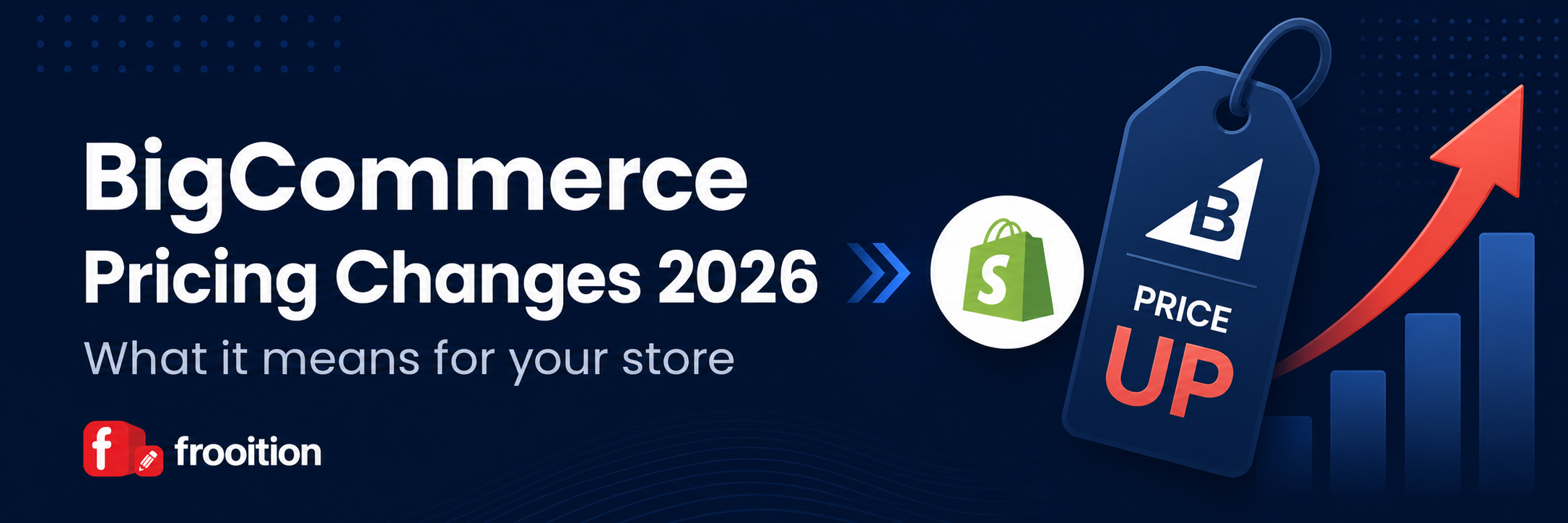
The BigCommerce pricing changes of June 2026 have left thousands of merchants reassessing their platform costs. Plan names changed, GMV thresholds tightened, and — most controversially — a new fee arrived for merchants using payment providers outside BigCommerce’s approved list.
If you’re on BigCommerce and you haven’t modelled what these pricing changes mean for your business yet, this post is for you. We’ll break down exactly what changed, explain what BigCommerce said in its own defence, and walk through why a growing number of merchants are using this moment to evaluate a move to Shopify — and how Frooition can make that migration seamless.
BigCommerce Pricing Changes: What Actually Changed on 1 June 2026
BigCommerce framed the June update as a refresh — new plan names, cleaner overage pricing, and a focused payments strategy. In practice, the changes are more significant than that framing suggests.
Plan Renames and Tightened GMV Thresholds
The four plans are now called Core, Growth, Scale, and Performance, replacing Standard, Plus, Pro, and Enterprise. The subscription prices haven’t changed on the surface, but the GMV thresholds that trigger automatic plan upgrades have:
The practical consequence: merchants who haven’t changed a thing can find themselves bumped to a higher-priced plan simply because BigCommerce moved the goalposts. A seller comfortably within the old Plus threshold at $120,000 annual GMV now exceeds the Growth cap and gets auto-upgraded to Scale.
The Open Payment Provider Fee
This is the change generating the most noise — and the most confusion. BigCommerce introduced a platform-level fee on orders processed through payment providers not on its Embedded list:
- Core: 2.0% of eligible order GMV
- Growth: 1.0%
- Scale: 0.6%
- Performance: governed by contract
BigCommerce’s list of “Embedded” (fee-free) providers includes Stripe, PayPal, Adyen, Klarna, Checkout.com, Amazon Pay, Afterpay, and around 20 others. If your gateway is on that list, the fee doesn’t apply.
If your gateway isn’t — think regional processors, specialist payment providers, or anything outside the approved 20+ — you pay a percentage on every order. For B2B merchants who use purchase orders, offline payment terms, or procurement workflows, BigCommerce’s own documentation notes these can also be subject to the fee.
Phone Support Removed from Core
Sellers on the entry-level Core plan also lost phone support, which now requires a Growth plan or above.
BigCommerce’s Defence of the Changes
In response to the backlash over its pricing changes, BigCommerce published a blog post setting the record straight, titled Setting the Record Straight: What’s Actually Changing With Our Pricing on June 1. Their case rests on three main points.
On the Payment Fee
BigCommerce argues the fee only applies to a narrow class of providers and that most merchants using major gateways will pay nothing extra. They pointedly contrast their 20+ fee-free Embedded providers against Shopify’s one fee-free option (Shopify Payments), suggesting they’re still the more open platform.
On the GMV Thresholds
BigCommerce says the new overage model is more gradual and predictable than the old one, which jumped in big chunks. That’s partially true for Scale — the continuous 0.9% overage is smoother than fixed revenue blocks. But the lower thresholds for Core and Growth mean many merchants get fewer sales for their money before a forced upgrade.
On Platform Value
BigCommerce points to significant R&D investment — Makeswift on Stencil, Feedonomics Surface, BigCommerce Payments, deeper promotional tools. These are genuine platform improvements, but they don’t directly offset the pricing impact for every seller.
Their counter-argument about Shopify’s transaction fees has merit: Shopify charges 0.2–2% on orders through third-party providers, and Shopify Payments isn’t available in every country. BigCommerce’s fee structure is arguably more transparent. But for merchants already on BigCommerce who weren’t modelling payment-provider fees into their cost base, the June change still represents an unwelcome surprise.
The Real Cost of the BigCommerce Pricing Changes
Here’s what the BigCommerce pricing changes actually look like in practice for a typical Growth seller with $80,000 in annual GMV, where 30% of orders run through an Open Payment Provider:
- Subscription: $948/year (annual billing)
- Open Payment Provider Fee: $80,000 × 30% × 1.0% = $240/year extra
- Payment processor fees: unchanged
That’s not catastrophic in isolation, but it’s real money that didn’t exist before — on top of whatever your payment processor charges. Scale the GMV up to $300,000 with a similar payment mix and the picture changes more substantially. For B2B merchants on offline payment terms, where all GMV might technically run through an Open Provider, the exposure could be significantly higher.
Why the 2026 BigCommerce Pricing Changes Make Now the Time to Consider Shopify
BigCommerce pricing changes often prompt a broader question: Is this still the right platform for where we’re going?
BigCommerce has always competed on openness and feature depth. But in recent years, Shopify has closed the feature gap significantly — particularly in B2B, multi-storefront, and headless commerce — while maintaining a larger ecosystem, more partner support, and stronger brand recognition among consumers and developers alike.
There are practical reasons to consider migrating now rather than later:
Your Data Is Clean and Accessible Right Now
Products, customers, orders, and pricing all sit in structured tables. Migrating now, before your catalogue grows further, keeps the project scope manageable. Waiting compounds the work.
The Tooling for BigCommerce-to-Shopify Migration Is Mature
Data mapping, redirect handling, and SEO preservation are all understood problems with established solutions. This isn’t uncharted territory — it’s a well-worn migration path with clear best practices.
The Design Opportunity
Moving platforms is the natural moment to reconsider your storefront design. You can either recreate what you have — a like-for-like migration that minimises risk — or use the move as a catalyst for a proper redesign that brings your brand up to date and improves conversion.
Frooition has handled both routes for dozens of merchants across every category. Whether you want continuity or a complete refresh, the migration is the right time to make that call.
What Frooition Can Do for Your BigCommerce to Shopify Migration
Frooition is a certified Shopify Partner with over 20 years’ experience in ecommerce design and migration. We’ve helped sellers of every size move from BigCommerce to Shopify, and we manage the full scope — not just the data transfer.
Full Data Migration
Every record moves across. Products, variants, inventory levels, customer accounts, order history, pricing rules — all migrated and validated before you go live. We don’t cut corners on data integrity because your order history and customer accounts are business assets, not just configuration files.
URL Redirects and SEO Preservation
One of the biggest risks in any replatform is the SEO cliff edge — existing search rankings disappearing because product and category URLs changed without redirects. Frooition maps every significant URL and implements the redirect structure before launch, protecting the organic traffic you’ve built. This is non-negotiable on every migration we run.
Design Options: Mirror or Overhaul
You have two routes with Frooition:
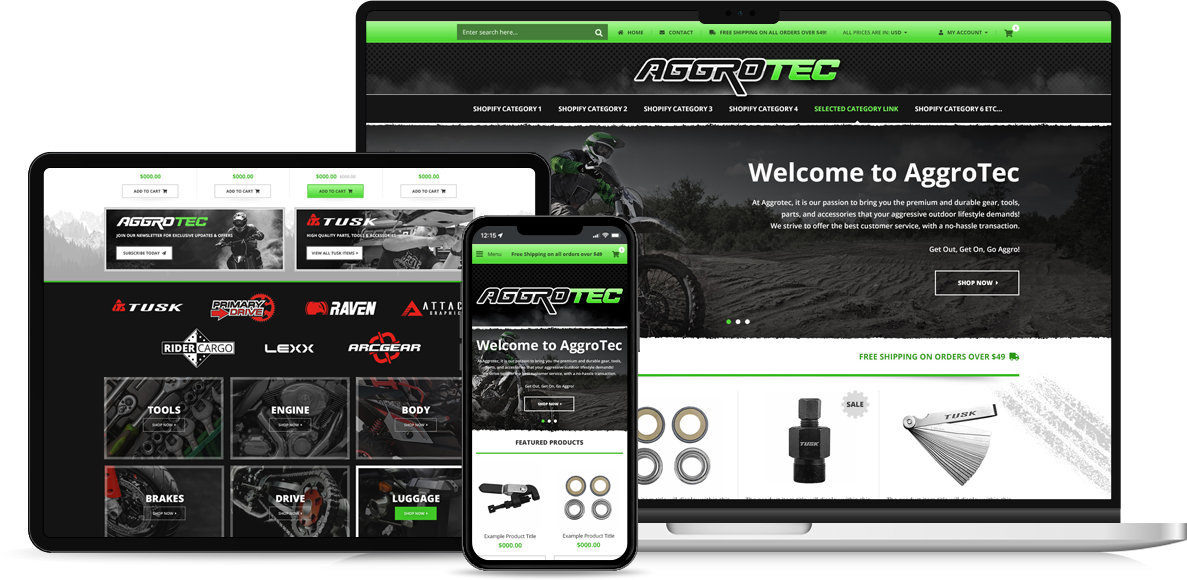
Mirror your existing BigCommerce design on Shopify. If your brand is established and your store converts well, we rebuild your existing look and feel in Shopify’s theme architecture — same visual identity, same user flows, modernised codebase. Lowest risk, fastest go-live. See our BigCommerce design portfolio for examples of the kind of work we’ve built on that platform, and our Shopify design portfolio to see where that design quality lands on the new platform.
Complete redesign and refresh. If your BigCommerce store has dated design, inconsistent branding, or conversion problems, migration is the ideal moment to fix them. Frooition designs and builds custom Shopify themes from scratch — your brand, your products, your customer journey, built properly from the ground up.
Both routes include mobile-first responsive design, full accessibility compliance, and performance optimisation as standard.
Ongoing Support
Post-migration, Frooition’s team handles ongoing design updates, campaign changes, and technical support. You don’t get handed a finished site and left alone to manage it.
What Frooition Migrates: The Full Scope
Is Shopify Always the Right Answer?
Honestly — not for every BigCommerce seller, and we’ll tell you that upfront.
If your store relies heavily on BigCommerce-specific B2B Edition features — company accounts, buyer portals, quote workflows — replicating those on Shopify typically requires a Shopify Plus subscription. That needs to be in your cost model before you decide.
And if your payment provider is on BigCommerce’s Embedded list and your GMV sits comfortably within one plan tier, the June changes may cost you very little. The upgrade question is less urgent in that case.
But if you’re already paying more than you expected, if your gateway is affected, if your brand presentation hasn’t kept pace with your business growth, or if you’ve always felt slightly constrained by BigCommerce’s ecosystem — this is a reasonable moment to have the conversation. We’re happy to help you model it honestly.
shopify design
Frequently Asked Questions
Can I migrate my BigCommerce store to Shopify without losing my order history and customer data?
Yes. Frooition migrates your complete order history, customer accounts, and associated data as part of every migration project. Nothing is deleted from your existing store — we work from your live data and validate everything before switching.
Will my Google rankings drop when I move from BigCommerce to Shopify?
Only if URL redirects aren’t implemented correctly. Frooition maps every significant product, category, and page URL and sets up 301 redirects before launch. This preserves your search equity during the transition. It’s one of the areas we’re most careful about on every migration.
Do I need Shopify Plus for B2B features?
Shopify’s B2B features — company accounts, custom pricing, purchase order workflows — are available on Shopify Plus. If B2B is a core part of your operation, that plan should be in your cost comparison. For predominantly B2C stores, standard Shopify plans are typically sufficient.
How long does a BigCommerce to Shopify migration take?
Timeline depends on catalogue size, customisation requirements, and whether you’re mirroring or redesigning. Frooition provides a project timeline at the start of each engagement. Most mid-sized merchant migrations complete within 6–12 weeks.
Can Frooition match my existing BigCommerce design on Shopify?
Yes. If you want a like-for-like migration with minimal visual disruption, Frooition rebuilds your existing design in Shopify’s theme architecture. Alternatively, we can use the migration as an opportunity for a complete brand refresh — see both options in our Shopify design portfolio.
What happens to my BigCommerce apps and integrations?
Shopify’s app ecosystem is extensive and covers almost every integration available on BigCommerce. Frooition audits your current apps and identifies Shopify equivalents — or native Shopify features that remove the need for a separate app entirely — as part of the migration scoping process.
What were the BigCommerce pricing changes in June 2026?
On 1 June 2026, BigCommerce renamed its four plans to Core, Growth, Scale, and Performance. GMV thresholds were reduced — Core now covers up to $30,000 annual GMV (previously $50,000) and Growth covers up to $100,000 (previously $180,000). BigCommerce also introduced an Open Payment Provider Fee of up to 2% on orders processed through payment providers not on its Embedded list. Phone support was also removed from the Core plan.
Ready to Talk Migration?
The best starting point is an honest conversation about your current setup — your GMV, your payment configuration, your catalogue size, and what your store needs to do next. From there, Frooition can scope the migration and give you a clear picture of what moves, how long it takes, and what the result looks like.
Talk to Frooition about migrating from BigCommerce →
No commitment, no pressure. Just a practical conversation about what’s involved and whether it makes sense for your business.
Further reading: Frooition Shopify design and build services · Frooition BigCommerce design services · Custom ecommerce website design
Share This Blog Post
Related Posts



Thanks! We'll be in touch within one business day.