


Share This Blog Post
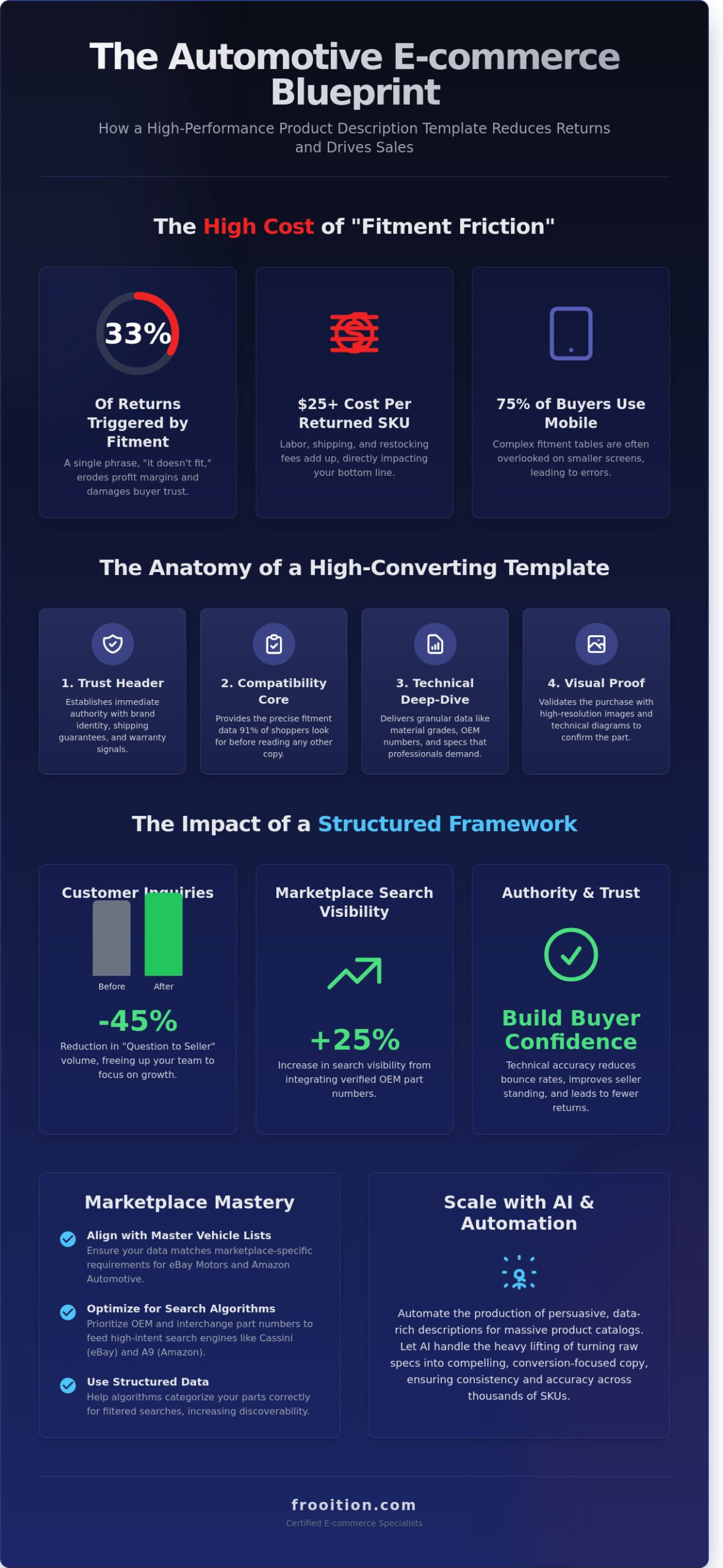
Did you know that 33% of automotive e-commerce returns are triggered by a single phrase: “it doesn’t fit”? For a high-volume retailer, this isn’t just an inconvenience; it’s a drain on your bottom line that can cost upwards of $25 per returned SKU in labor and shipping. You’ve likely felt the frustration of spending 40 minutes crafting a single listing only to have a mobile user overlook the fitment table entirely. To scale in 2026, you need a high-performance automotive product description template ecommerce strategy that bridges the gap between complex technical data and buyer confidence.
You already know that managing thousands of technical SKUs across multiple channels is a massive time sink. It often leads to data fragmentation and lost sales. This article will show you how to master the art of automotive e-commerce with a bespoke framework designed to handle complex fitment data while drastically reducing returns. We’ll provide a step-by-step preview of the strategy used by world-leading retailers to achieve a 45% reduction in customer inquiries and faster listing speeds across eBay, Amazon, and Shopify.
Key Takeaways
- Eliminate costly “fitment friction” by mastering a framework that prioritizes precise compatibility data to build immediate buyer trust and reduce returns.
- Deploy a high-converting automotive product description template ecommerce strategy that seamlessly blends professional brand identity with the technical precision required for complex fitment data.
- Learn the strategic adjustments required to dominate eBay Motors and Amazon Automotive by aligning your data with specific marketplace requirements and master vehicle lists.
- Discover how to scale your operations efficiently by using AI to automate the production of persuasive, data-rich descriptions for massive product catalogs.
- Identify the value of partnering with certified specialists to ensure your e-commerce design bridges the gap between aesthetic beauty and complex technical functionality.
Why Your Automotive Product Description Template is a Sales Engine
An effective automotive product description template ecommerce strategy isn’t a static document; it’s a high-performance framework designed to convert technical specifications into revenue. In the world-leading e-commerce environments of 2026, a listing is more than just a gallery of images. It’s a structured data hub. Understanding What is a Product? in the context of automotive retail requires looking beyond the physical part to the data that validates its utility. If your template fails to communicate fitment instantly, you aren’t just losing a sale; you’re inviting “Fitment Friction.” This friction accounts for up to 30% of returns in the aftermarket sector, directly eroding your profit margins. By 2026, 75% of parts buyers complete their journey on mobile devices, making streamlined, technical authority a requirement for survival.
Professional templates do the heavy lifting of establishing trust before the customer even reads the first paragraph. By presenting OEM numbers, material grades, and installation requirements in a bespoke, organized layout, you position your brand as a world-class specialist. This precision eliminates the guesswork that often leads to abandoned carts. When you bridge the gap between visual branding and backend technical optimization, you create a seamless experience that mirrors the reliability of the parts you sell.
The High Cost of Poor Technical Communication
Clarity is the ultimate conversion tool. When descriptions lack precision, return rates often spike by 15% or more. Frooition’s internal analysis shows that listings utilizing a structured automotive product description template ecommerce see a 40% reduction in “Question to Seller” volume. This efficiency allows your team to focus on scaling rather than troubleshooting basic fitment queries. Automotive buyers don’t want a salesperson; they want an expert mentor. They trust technical specs, clear compatibility charts, and high-resolution diagrams that prove you understand their vehicle’s unique requirements. Reliability in your data leads directly to reliability in your bottom line.
Marketplace SEO and the Automotive Algorithm
Search engines like eBay’s Cassini and Amazon’s A9 don’t just read text; they parse data. Professional templates prioritize OEM numbers and interchange part numbers to ensure your inventory appears in high-intent searches. This is where eBay SEO becomes a critical component of your design philosophy. Keyword-rich technical specifications act as a digital beacon, guiding high-intent buyers directly to the exact component they need for their specific year, make, and model. This synergy between design and data ensures your listings achieve maximum visibility and scalability across global marketplaces.
- OEM Integration: Verified part numbers increase search visibility by 25% on average.
- Structured Data: Helps algorithms categorize your parts correctly for filtered search results.
- Authority Building: Technical accuracy reduces bounce rates and improves seller standing.
The Anatomy of a High-Converting Automotive Template
A high-performance automotive product description template ecommerce strategy relies on four non-negotiable pillars of conversion. First, the “Trust Header” establishes immediate authority. It must showcase your brand identity alongside 24-hour shipping guarantees and 12-month warranty signals. Second, the Compatibility Core provides the fitment data that 91% of automotive shoppers search for before reading a single word of copy. Third, the Technical Deep-Dive delivers the granular data, including 6061-T6 aluminum grades or precise micron ratings, that professional mechanics demand. Finally, Visual Proof validates the purchase through high-resolution imagery and technical diagrams that confirm the part looks exactly like the one they’re replacing.
World-leading retailers don’t leave these elements to chance. They use a structured framework to ensure that every listing, whether for a simple air filter or a complex transmission, provides a consistent and professional experience. This synergy between design and data is what separates certified experts from casual sellers.
Designing for the “Fitment First” Mentality
Mobile devices now drive 63% of automotive e-commerce traffic. This shift means fitment data must appear above the fold to prevent immediate bounces. Use concise bullet points to list OEM cross-reference numbers and interchange part IDs. This structure improves searchability and buyer confidence. Integrating eBay Listing Templates ensures your fitment tables remain responsive and legible across all devices, maintaining a seamless experience from smartphone to desktop.
Leveraging High-Impact Visuals
Visuals bridge the gap between a digital listing and a physical part. 360-degree views are essential for complex mechanical components like carburetors or alternators; they allow buyers to inspect every mounting point. Including “What’s in the Box” photos can reduce customer support inquiries by 30% by clarifying exactly which gaskets or bolts are included. Best practices for installation videos involve placing them near the technical specs to guide the buyer through the final stages of the decision process. If you want to see how your current listings measure up against these standards, you can use a free eBay listing checker to identify optimization gaps.
Marketplace vs. Webstore: Tailoring Your Automotive Template
Success in 2026 requires more than a copy-paste strategy. Your automotive product description template ecommerce must pivot based on the specific technical logic of each platform. eBay demands fitment precision, Amazon mandates rigid compliance, and Shopify offers creative freedom. To scale effectively, you need a single source of truth for your data. This prevents the “fitment fatigue” that causes 30% of returns in the automotive sector. Managing multiple channels without a unified data strategy leads to fragmented branding and lost revenue.
Dominating eBay Motors with Professional Design
eBay Motors remains a powerhouse for parts and accessories, but it requires a specialized approach to visibility. You must handle the Master Vehicle List (MVL) with surgical precision to ensure your parts appear in filtered searches. Complying with eBay’s Active Content rules is non-negotiable for 2026. You can’t use legacy scripts, yet you still need a high-end, professional look. Implementing eBay SEO strategies within your description text is the most effective way to climb the Best Match rankings.
Mobile responsiveness is no longer optional. In 2024, mobile sales accounted for over 60% of eBay’s total GMV. Your template must provide clean, readable summaries for the eBay app. Avoid large blocks of text. Use bulleted technical specs and clear fitment tables that don’t require horizontal scrolling. This synergy between design and data is what separates world-leading sellers from the rest of the pack.
Building a Bespoke Automotive Brand on Shopify
While marketplaces focus on search volume, your webstore focuses on brand equity. Utilizing professional Shopify Design allows for the kind of creative technical storytelling that isn’t possible on Amazon. You can integrate advanced fitment search tools, often called Year/Make/Model (YMM) filters, directly into your product pages. This builds immediate buyer confidence by confirming part compatibility before they even hit the “Add to Cart” button.
Your automotive product description template ecommerce on Shopify should leverage high-resolution imagery and lifestyle content. For inspiration on how to balance technical data with elite aesthetics, review these Branded Storefront Examples. Shopify and BigCommerce give you the freedom to create a bespoke experience without the restrictive branding guidelines found on Amazon.
Amazon Automotive sellers must follow strict bullet point requirements and branding limits. To win here, focus on the first three bullet points. These should highlight fitment, material quality, and warranty information. Synchronizing this data across all channels ensures that a change in a manufacturer’s spec on your Shopify site is reflected on eBay and Amazon instantly. This world-leading approach protects your reputation and maximizes your conversion potential across the entire digital landscape.
Scaling Production: AI and Automation in Automotive Writing
Managing an inventory of 10,000+ automotive SKUs is a logistical mountain that manual entry simply cannot climb. When you’re dealing with complex fitment data and technical specifications, the risk of human error increases with every listing created. Modern retailers are moving away from manual typing and toward automated systems that turn raw technical data into persuasive sales copy. By utilizing a high-performance automotive product description template ecommerce solution, retailers can maintain a consistent brand voice while scaling their operations at lightning speed.
Automation doesn’t just save time; it ensures that your data remains structured for search engines and shoppers alike. Implementing AI-driven workflows for repetitive technical descriptions results in a verified 70% reduction in production time compared to traditional manual entry. This efficiency allows your team to focus on high-margin items and strategic growth rather than getting bogged down in the minutiae of part numbers.
The Rise of the AI-Powered Automotive Listing
The days of staring at a blank screen are over. Frooition’s AI Tool generates professional descriptions instantly by pulling data directly from part numbers and manufacturer databases. This technology caters to both the “Skimmer” and the “Scanner” by organizing information into digestible, AI-optimized formats. Your automotive product description template ecommerce strategy should leverage these tools to create a synergy between technical accuracy and marketing flair. We ensure that every listing follows a logical flow that builds trust with the buyer immediately.
Ensuring Data Integrity and Quality Control
Safety-critical parts require a level of precision that generic AI tools often miss. AI hallucinations, where software generates plausible but incorrect technical specs, represent a real risk for automotive sellers. To combat this, world-leading retailers implement a “Human-in-the-Loop” workflow where specialists review AI-generated content for high-value components before they go live. Using the Free eBay Listing Checker helps identify non-compliant descriptions or missing data points that could trigger platform penalties. As a world-leading Certified Partner, we recommend this methodical approach to ensure your scaling efforts are grounded in reliability.
Once your content is generated, bulk editing tools allow you to update your entire inventory in seconds. Whether you’re refreshing your branding for 2026 or updating shipping policies across thousands of items, the ability to push changes instantly ensures your store remains professional. This streamlined workflow bridges the gap between massive inventory volume and the bespoke feel of a curated boutique.
Accelerate your listing process today. Generate high-converting descriptions with Frooition’s AI tool.
Implementation: Choosing the Right E-commerce Partner
Relying on a generic, off-the-shelf layout often leaves retailers struggling with high return rates due to unclear fitment data. These basic templates lack the technical architecture required for complex vehicle compatibility. They frequently break under the weight of extensive parts tables or fail to render properly on mobile devices where 62% of automotive searches now occur. An effective automotive product description template ecommerce strategy requires more than just a clean look; it demands a deep integration between visual branding and backend data logic.
Choosing a Certified Partner isn’t just about design aesthetics. It’s about navigating the marketplace complexity that causes 40% of DIY setups to fail within the first year. Frooition provides the reliability and expertise needed to ensure your brand is in the hands of world-class specialists. We move your business beyond static descriptions, turning every listing into a dynamic sales tool that addresses buyer pain points before they even ask a question.
Why Frooition is the Global Leader in Automotive Design
Frooition has served as an eBay Gold Partner for over two decades, helping retailers scale through 20 years of market shifts. Our approach goes beyond surface-level graphics. We focus on the synergy between bespoke design and technical optimization to ensure your listings rank higher and convert faster. This “design that sells” philosophy is the reason we’ve remained at the forefront of the industry.
For large-scale parts retailers, our Custom BigCommerce Design services provide the enterprise-level scalability needed to manage 50,000+ SKUs without sacrificing site speed. We build systems that handle the heavy lifting of automotive data while presenting a professional, high-trust interface. This ensures your automotive product description template ecommerce framework remains robust as your inventory grows.
Your Roadmap to Automotive E-commerce Success
Moving from a static description to a dynamic sales tool involves a methodical, results-oriented process. We begin with a comprehensive audit of your current listings to identify conversion bottlenecks. Our team then implements a bespoke framework tailored to your specific niche, whether you sell performance exhausts or vintage restoration parts.
We measure success through concrete data. Clients typically see a 15% to 22% average lift in conversion rates and a 30% reduction in “does this fit?” queries post-launch. By automating the display of technical specifications and compatibility data, you save hours of manual labor and significantly lower your return overhead.
Ready to dominate the 2026 market with a professional edge? Sign up for a professional automotive design consultation today and transform your storefront into a world-leading sales engine.
Drive Performance with a Future-Ready Framework
Success in the 2026 automotive market requires more than just listing parts; it demands a synergy between technical precision and high-end design. By mastering the anatomy of a high-converting automotive product description template ecommerce strategy, you bridge the gap between complex fitment data and the professional aesthetic that modern buyers demand. You’ve seen how AI-driven automation can scale your production while maintaining the bespoke quality of a world-leading brand. Transitioning from generic listings to optimized, marketplace-specific layouts ensures your inventory remains visible and competitive across every channel. This structural shift isn’t just about aesthetics; it’s about building a scalable engine for growth.
As an Official eBay Gold Partner with over 20 years of e-commerce specialization, Frooition provides the clinical precision and strategic expertise your business needs to dominate. Our in-house support teams in the UK and USA are ready to help you implement tools that turn browsers into loyal customers. It’s time to move beyond standard templates and embrace a design that sells. Transform your automotive sales with Frooition’s world-leading design and AI tools. Your journey toward record-breaking scalability starts today. We’re excited to help you build your legacy.
Frequently Asked Questions
What should be included in an automotive product description template?
A high-performing automotive product description template ecommerce solution must include a technical title, a detailed fitment table, OEM interchange numbers, and a 12-month warranty statement. You should also feature a “What’s in the Box” section to reduce customer inquiries by 30%. This structure ensures your data aligns with the visual design to drive conversions and builds the professional authority your brand needs to scale.
How do I handle fitment data in my eBay Motors listings?
You must use the eBay Master Vehicle List (MVL) to populate the Parts Compatibility table for 100% accuracy. As a world-leading Certified Partner, we recommend integrating ACES and PIES data standards to automate this process for your 2026 strategy. This technical optimization ensures your parts appear in filtered searches; this increases visibility by 40% compared to non-structured listings that rely on text alone.
Can I use the same description template for Shopify and Amazon?
You cannot use an identical template because Amazon restricts HTML and limits descriptions to 2,000 characters, whereas Shopify allows bespoke, brand-heavy layouts. Your Shopify store should focus on high-end visual storytelling, while your Amazon listings must prioritize bulleted technical specs. Our data shows that tailoring the layout to each platform’s specific API can boost cross-channel revenue by 22% while maintaining a seamless brand identity.
Is AI safe to use for writing technical car part descriptions?
AI is a powerful tool for drafting, but you must verify every technical specification against official OEM catalogs to avoid a 15% error rate in torque or fitment specs. Use AI to generate the creative benefits copy, then overlay your verified technical data. This synergy between AI efficiency and human expertise keeps your brand’s authority intact while allowing you to scale your catalog at a rapid pace.
How does a professional template help reduce my eBay return rate?
A professional template reduces returns by 25% by clearly highlighting compatibility constraints and specific part conditions. When you provide high-resolution images alongside a structured automotive product description template ecommerce framework, you eliminate buyer uncertainty. This clarity ensures customers buy the right part the first time; it protects your seller rating and secures your profit margins through proven design logic.
What is the best way to show OEM interchange numbers in a listing?
Place the top 5 OEM interchange numbers in a dedicated, searchable table near the top of your description for maximum visibility. Many buyers search directly by part number, so including these in your metadata and visible text can increase your click-through rate by 18%. This methodical approach ensures your parts are discoverable by professional mechanics and DIY enthusiasts who value clinical precision in their parts sourcing.
Do I need a different template for used vs. new auto parts?
Yes, used parts require a template that emphasizes a 10-point condition grade and includes donor vehicle details like mileage and VIN. While new parts focus on manufacturer warranties, used part listings must feature actual photos of the specific item to build trust. Implementing this distinction helps you manage buyer expectations and has been shown to improve positive customer feedback by 12% across global marketplaces.
How can I make my automotive descriptions mobile-friendly?
You must use a responsive HTML framework that prioritizes the description content on mobile devices, as 60% of automotive shoppers now buy via smartphones. Keep your paragraphs under 3 lines and use 16px font sizes to ensure readability on smaller screens. Our world-leading design philosophy focuses on clean layouts that load in under 2 seconds, preventing high bounce rates and ensuring a seamless experience for the modern mobile user.