Share This Blog Post
Overselling on eBay: a sale that costs more than the refund
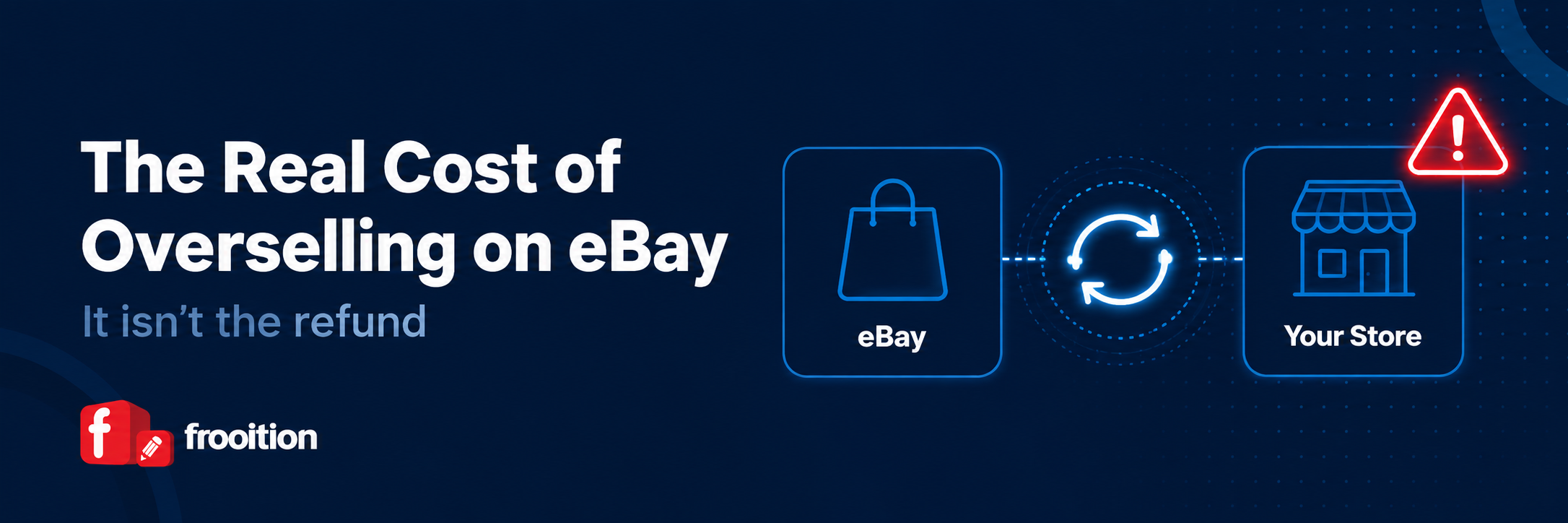
Overselling on eBay looks like a small operational hiccup from the outside — a customer gets a refund, you apologise, everyone moves on. What it actually costs is a cancellation against your account, a possible defect rate hit, and in enough repeat cases, a threat to Top Rated Seller status that took months to earn. None of those consequences show up in the moment; they accumulate quietly until a status review catches up with the pattern. Underneath almost every case is the same root cause: stock figures that drift out of step between the places you sell, not a careless seller — and the fix that actually prevents overselling on eBay is simpler than most sellers expect.
The seller running three spreadsheets at once
A multichannel seller lists the same 40 units across eBay, a marketplace listing on another site, and an in-store till. Every sale on any one of them has to be manually subtracted from the other two before someone else buys the same stock that’s already gone. Miss one update during a busy afternoon and the ninth sale of a nine-unit run happens twice — to two different buyers, only one of whom can actually receive the item.
How to prevent overselling on eBay, even under pressure
The problem isn’t carelessness. It’s that stock sync across channels is a real-time problem being solved with manual, batch-timed updates. A seller checking stock levels once an hour is, in effect, running on stale data for up to fifty-nine minutes out of every sixty — plenty of time for a busy afternoon to sell through the gap. eBay itself has acknowledged the friction multichannel sellers face around inventory accuracy, particularly for sellers running parts and accessories across several platforms at once.
How an oversold item on eBay hits your cancellation rate
Every cancellation from overselling counts against the same metrics eBay uses to calculate seller performance standards. A seller with an otherwise clean account can still see cancellation rate creep upward purely from sync gaps, with no other change in how the business is run — which makes the cause easy to misdiagnose as something else entirely.
Where Frooition fits, and where it doesn’t
Frooition doesn’t hold your stock figures or sync quantities between channels, so on its own it won’t stop an oversell. That job belongs to a dedicated stock sync or inventory system that updates every channel the moment a sale happens. Frooition handles the listing side: our eBay inventory management tools let you see every listing across your eBay accounts, find the ones with outdated details and change thousands at once, including quantities with eBay Bulk Revision when a stock count needs correcting by hand. If you sell on Shopify and eBay, ask us about FrooSync – it’s currently set up manually while Shopify App Store approval is pending.
What this doesn’t solve
Real-time sync can’t fix a stock count that was wrong to begin with, or a channel that isn’t connected at all. Stock sync closes the gap between systems, not errors within them — a miscounted physical stocktake will still oversell even with perfect real-time sync, because the underlying number being synced was already wrong.
Why overselling on eBay compounds across a multichannel inventory
The overselling risk multiplies with every additional sales channel a seller adds. Two channels means one sync gap to manage; five channels means a sync gap between every pair, which grows far faster than the channel count itself. Sellers scaling from one channel to several often don’t realise the sync-risk math has changed until an oversold item makes it obvious — which is exactly why real-time inventory sync matters more with every channel you add. eBay’s own directory of third-party inventory-sync providers is a reasonable signal of how common this problem has become across the platform.
Common questions
How fast does “real-time” sync actually need to be to prevent overselling? Close enough that two near-simultaneous sales on different channels can’t both go through — in practice, sync measured in seconds rather than the batch-hour intervals many manual processes run on.
Does this apply to sellers only on eBay, with no other channels? Less directly — the main risk is cross-channel sync gaps. A single-channel eBay seller’s overselling risk usually comes from stock count errors rather than sync delay, which is a different problem to solve.
What’s the actual defect-rate impact of one oversold item? It varies by account history, but a cancellation from overselling counts the same as any other seller-caused cancellation in eBay’s performance calculations — the risk is cumulative pattern, not any single incident.
Is overselling on eBay any different from other channels? Mainly in the consequences — eBay ties cancellations and defect rate directly to account-level status like Top Rated Seller, so a sync gap turns into an account-health problem faster than it would on a channel with looser performance metrics.
What to do next
If overselling has cost you a cancellation in the last few months, tightening up how your stock syncs between channels now is cheaper than rebuilding Top Rated status later. While you’re at it, see what every one of your eBay listings is missing – reading your whole inventory is free.
Share This Blog Post
Related Posts


Thanks! We'll be in touch within one business day.