
Share This Blog Post
In 2026, your digital flagship is the only thing standing between a customer’s bounce and a high-value conversion. While over 80% of shoppers now use brand stores to validate their purchases, many retailers still struggle with an amazon storefront design that feels generic or misaligned. You’ve likely felt the pressure to maintain brand consistency across a fragmented marketplace, or perhaps you’re worried that a lack of technical expertise is holding your growth back. We understand that frustration because we’ve spent years bridging the gap between high-end aesthetics and clinical data precision.
This guide will teach you how to create a bespoke shopping experience that amplifies your presence and drives sales. As a world-leading certified partner, we’ve seen how the right synergy between design and data can transform a stagnant catalog into a scalable powerhouse. We’ll provide a methodical, step-by-step breakdown of the conversion-focused elements you need to build a visually compelling, high-performing storefront that resonates with serious buyers and reflects your brand’s elite status.
Key Takeaways
- Discover how a dedicated brand hub enhances visibility and establishes the professional credibility required to dominate your market.
- Master the strategic process of amazon storefront design to select high-performing layouts that align with your specific product range and business goals.
- Learn to integrate consistent visual branding and compelling narratives that resonate with customers and build long-term brand loyalty.
- Identify the specific design elements and A/B testing strategies needed to highlight your bestsellers and maximize your conversion potential.
- Explore how the synergy between bespoke design and data-driven optimization can scale your brand presence through world-leading e-commerce expertise.
Understanding Amazon Storefront Design: Why It Matters
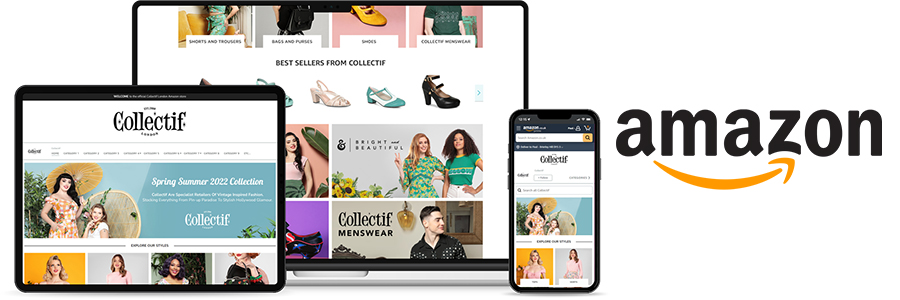
An Amazon Storefront functions as a dedicated, multi-page brand hub within the vast ecosystem of the Amazon Marketplace. It’s far more than a simple collection of listings; it’s a bespoke digital flagship where you control the narrative and the customer journey. Professional amazon storefront design transforms a standard shopping experience into an immersive brand environment, shielding your customers from the competitor ads that typically clutter individual product pages. This isolation is critical for maintaining focus and driving higher average order values.
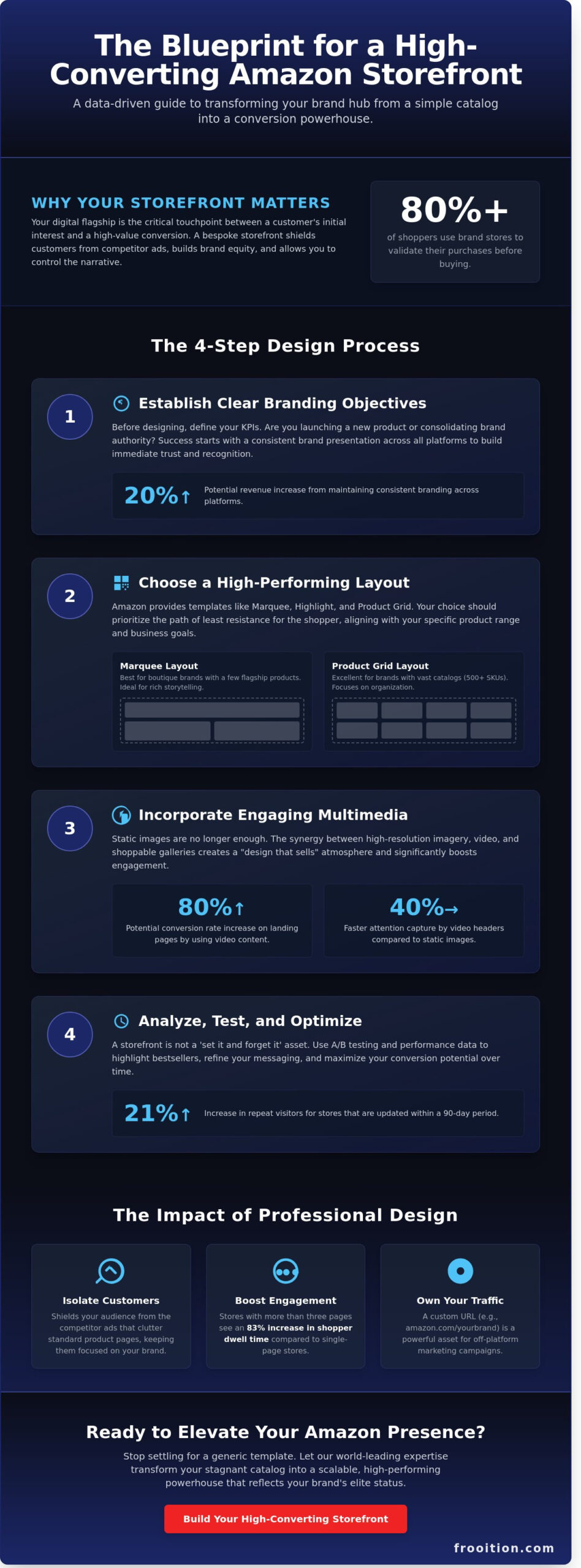
Owning a custom Amazon URL, such as amazon.com/yourbrand, provides a powerful asset for off-platform marketing. When you drive external traffic from social media or email campaigns to a curated storefront rather than a single product listing, you’re building long-term brand equity. Data from Amazon indicates that stores updated within the last 90 days see a 21% increase in repeat visitors. This proves that a dynamic, well-maintained presence drives sustained growth and customer loyalty. At Frooition, we emphasize the synergy between design and data, ensuring your store isn’t just beautiful but optimized for maximum scalability.
Key Features of an Amazon Storefront
Effective storefronts leverage high-definition images, background videos, and shoppable galleries to create a “design that sells” atmosphere. By utilizing a cohesive brand narrative, you bridge the gap between clinical data and creative excitement. Key elements include:
- Product Showcases: Highlight best-sellers or new arrivals using dynamic widgets that update automatically.
- Interactive Elements: Use shoppable images that allow users to click a product within a lifestyle photo to see price and availability instantly.
- Rich Media: Video headers capture attention 40% faster than static images in a crowded digital space.
Common Misconceptions About Amazon Storefronts
Many retailers believe these premium hubs are reserved for global conglomerates. That’s a mistake. Any seller with a registered trademark and Amazon Brand Registry can launch a store. The setup requires zero coding knowledge, as the platform uses a standardized drag-and-drop Store Builder. Cost is another area of confusion. Creating a storefront involves no additional fees beyond your existing professional seller subscription. This accessibility allows growing businesses to achieve a world-leading aesthetic without a massive capital investment. As a Certified Partner, we help brands leverage these free tools to achieve elite-level performance and conversion.
Step-by-Step Guide to Designing Your Amazon Storefront
Building a high-performance amazon storefront design requires more than just uploading a logo. It’s a strategic exercise in brand architecture. Amazon’s internal data from 2023 indicates that stores with more than three pages see an 83% increase in dwell time compared to single-page stores. To capture this engagement, follow this methodical four-step process.
Before entering the builder, define your KPIs. Are you launching a new product line or consolidating brand authority? Success starts with consistency. According to a 2024 report by Marq, consistent brand presentation across platforms can increase revenue by up to 20%. Ensure your color palette, typography, and voice mirror your external site to build immediate trust.
Step 2: Choose a design layout that aligns with your product range
Amazon provides several templates, such as Marquee, Highlight, and Product Grid. A brand with a vast catalog of 500+ SKUs benefits from the Product Grid’s organizational power, while a boutique brand with five flagship items should utilize the Marquee layout to tell a richer story. Your amazon storefront design should prioritize the path of least resistance for the shopper.
Step 3: Incorporate engaging multimedia content
Static images are no longer enough to win the Buy Box. The synergy between high-resolution imagery and strategic messaging is central to visual branding in e-commerce, as highlighted by the National Association for the Self-Employed (NASE). Video content can increase conversion rates by 80% on landing pages, so integrate lifestyle clips that demonstrate your product in action.
Step 4: Utilize Amazon’s Store Insights for performance tracking
The “Insights” tab provides granular data on traffic sources, sales per visit, and page views. Analyze which sub-pages have the highest bounce rates. If your “Best Sellers” page is underperforming, it’s a signal to refresh the creative assets or adjust the layout for better flow.
Setting Up Your Amazon Storefront
Access begins with Amazon Brand Registry. Once verified, you’ll gain access to the Store Builder in the Advertising console. Don’t settle for the default settings; navigate the interface to create custom tiles that reflect your elite status. While templates offer a starting point, world-leading brands use bespoke modules to differentiate themselves from the competition. If you’re looking to scale your presence across platforms, a bespoke Shopify design can complement your Amazon strategy perfectly.
Design Tips for Optimal User Experience
Accessibility is the foundation of high-end design. Ensure your navigation is intuitive by grouping products into logical categories. Use high-quality videos (1080p minimum) and crisp photography to eliminate buyer hesitation. Every page must include a strategic call-to-action (CTA), whether it’s a “Shop Now” button or a link to a curated collection. Amazon’s 2023 performance metrics show that stores updated within the last 90 days see 21% more repeat visitors, so keep your content fresh and seasonally relevant.
Aligning Storefront Design with Your Brand Strategy
Your brand strategy shouldn’t be a static document tucked away in a folder. It’s a living framework that must dictate every pixel of your amazon storefront design. Integrating your specific hex codes and logos consistently is the first step toward building a world-class presence that commands attention. Studies from the University of Loyola show that color boosts brand recognition by 80%. This isn’t just about looking good; it’s about the clinical precision of conversion optimization. A cohesive look signals to the shopper that they’ve reached the official home of a brand they can trust.
Trust isn’t just earned; it’s designed. By weaving customer testimonials and verified reviews into your layout, you provide the social proof required to close the sale. Research from 2021 indicates that 93% of buyers are influenced by online reviews. When you combine this data with high-impact visuals, you create a retail environment that feels both prestigious and reliable. You’re not just listing products; you’re validating the customer’s choice through the experiences of others.
Synchronizing your storefront messaging with external marketing efforts is a hallmark of a sophisticated retail strategy. If your current Instagram campaign highlights a specific lifestyle benefit, your amazon storefront design should reflect that same value proposition prominently. This alignment ensures that the customer journey remains frictionless from the first click to the final checkout. When your messaging is fragmented, you risk losing the momentum generated by your advertising spend.
Brand Consistency Across Platforms
Elite retailers don’t operate in a vacuum. Your identity must remain uniform whether a customer finds you on Amazon, eBay, or Shopify. Fragmented branding confuses shoppers and erodes your authority as a market leader. Lucidpress reports that consistent branding across all platforms can increase revenue by 33%. As a world-leading agency, we specialize in creating a unified visual language that scales with your business. You can explore Frooition’s services for cross-channel design to ensure your brand remains recognizable and professional across the entire e-commerce ecosystem.
Telling Your Brand Story Through Design
Narrative-driven content transforms a simple shop into a destination. Use your storefront to highlight brand milestones, such as your founding year or major industry certifications. Incorporating lifestyle imagery allows visitors to see your products in a real-world context, creating an emotional connection that technical specs can’t achieve. According to Search Engine Watch, narrative storytelling can boost conversion rates by 30%. This bespoke approach ensures your design sells your vision, not just your inventory, making your brand feel both innovative and grounded in proven success.
Maximizing Conversion with Strategic Storefront Elements
High-performance amazon storefront design isn’t just about aesthetics; it’s a calculated exercise in conversion science. To transform casual browsers into loyal customers, you must direct their attention with clinical precision. Start by identifying your top 10% of products, which typically generate the majority of your revenue. These best-sellers deserve prime real estate at the top of your homepage. By featuring these proven winners prominently, you reduce friction and provide immediate social proof to new visitors.
Data-driven retailers don’t guess; they test. Utilizing Amazon’s “Manage Your Experiments” tool allows you to A/B test different hero images, headlines, and product layouts. Industry data from 2023 suggests that brands engaging in regular A/B testing see an average conversion lift of 25%. This iterative process ensures every pixel on your page earns its place. Simultaneously, you should integrate customer feedback loops by monitoring the “Questions and Answers” section of your listings. If customers frequently ask about a specific feature, highlight that feature visually within your storefront layout to preemptively address objections.
Promoting special offers and discounts effectively requires a balance of visibility and brand integrity. Use the dedicated “Deals” widget to aggregate all active promotions in one place. This creates a high-energy shopping environment that encourages multi-item orders. The synergy between design and data ensures that your promotions feel like exclusive opportunities rather than desperate clearances.
Design Elements That Drive Conversion
Urgency and scarcity are powerful psychological triggers when used ethically. Incorporate “Limited Time Offer” banners or seasonal countdowns to encourage immediate action. Dynamic product showcases, such as “Recommended for You” carousels, personalize the experience for returning shoppers. Don’t overlook the power of authenticity; incorporating user-generated content (UGC) is essential. A 2023 Stackla report found that 79% of people say UGC highly impacts their purchasing decisions, making it a critical component of a trustworthy brand presence.
Measuring Success: Using Amazon Store Insights
Success in the e-commerce space is measured by scalability and performance metrics. Amazon Store Insights provides a granular look at your daily visits, views, and sales per visitor. By analyzing these metrics, you can identify which pages are leaking traffic and which are over-performing. This allows for a bespoke optimization strategy that evolves with market trends. For a deeper dive into future-proofing your brand, consult our Amazon Brand Store Design guide for a 2026 strategic perspective. The ultimate goal of amazon storefront design is to create a seamless path to purchase that reflects your status as a market leader.
How Frooition Can Elevate Your Amazon Storefront
Scaling a brand in a competitive marketplace requires a sophisticated partner who understands that aesthetics must serve the bottom line. Frooition brings world-leading expertise to every project, having supported more than 5,000 brands globally in their quest for digital dominance. We don’t just build pages; we engineer high-converting environments. Our team focuses on the intersection of professional authority and creative innovation to deliver an amazon storefront design that captures attention and builds long-term customer loyalty.
Our full-service approach eliminates the friction often found in complex digital transformations. We handle everything from the initial design strategy to the final implementation and backend optimization. By integrating proprietary tools and advanced AI-driven enhancements, we give our clients a distinct technical advantage. This ensures your brand isn’t just keeping pace with the market but setting the standard for others to follow. We prioritize a “design that sells” philosophy, ensuring that every pixel serves a purpose in the buyer’s journey.
Client Success Stories
The impact of a professional redesign is often immediate and measurable. For instance, in a project completed in December 2023, a major retail partner experienced a 30% increase in conversion rates within the first ninety days of their launch. This success stemmed from a streamlined navigation structure and a more cohesive brand narrative. One of our long-term clients recently shared that our team’s ability to blend clinical precision with creative excitement has been a cornerstone of their global growth. This level of results-oriented enthusiasm is what separates us from standard agencies.
Why Choose Frooition?
Our status as a Certified Partner with leading e-commerce platforms provides our clients with an essential layer of trust and validation. This certification confirms that our technical workflows and design standards are world-class. We offer a seamless experience that covers every detail of your amazon storefront design, from the first sketch to the final live store. Our experts act as elite consultants, providing the strategic roadmap you need to scale. To learn more about how we can transform your presence, explore Frooition’s Amazon Storefront services and see the difference that expert design can make.
Future-Proof Your Brand for the 2026 Amazon Marketplace
Success in 2026 requires more than just a digital catalog; it demands a seamless synergy between high-end aesthetics and technical precision. You’ve seen how aligning your brand strategy with a bespoke layout creates a world-leading shopping experience that resonates with modern consumers. Strategic placement of conversion-focused elements ensures your store isn’t just beautiful but also acts as a high-performance sales engine. Mastering amazon storefront design is a complex journey, but you don’t have to navigate it alone.
Frooition brings over 20 years of e-commerce design expertise to your project. As a certified partner with major platforms, we utilize proprietary AI-driven optimization tools to maximize your visibility and conversion rates. Our team of world-class specialists bridges the gap between creative vision and data-backed performance to ensure your brand stands out in a crowded marketplace. Enhance your Amazon Storefront with Frooition’s expert design services! It’s time to scale your business with a design that truly sells.
Frequently Asked Questions
What is an Amazon Storefront and how does it work?
An Amazon Storefront is a dedicated, multi-page branded destination within the marketplace that allows Brand Registry sellers to showcase their entire product catalog. It functions as a bespoke mini-website, providing a distraction-free shopping environment where customers explore your brand identity without seeing competitor ads. By leveraging customizable tiles and templates, you create a curated experience that drives higher units per order through strategic cross-selling.
How much does it cost to set up an Amazon Storefront?
Creating an Amazon Storefront is free for sellers and vendors enrolled in the Amazon Brand Registry program. While Amazon doesn’t charge a subscription fee for the Storefront itself, you must have an active professional seller account, which costs $39.99 per month as of 2024. Investing in professional amazon storefront design services is a common choice for brands aiming to maximize their return on investment through superior visual storytelling.
Can small businesses benefit from Amazon Storefronts?
Small businesses gain a competitive edge by using Storefronts to build brand equity and trust alongside global retailers. Internal Amazon data indicates that stores updated within the last 90 days see 21% more repeat visitors and higher average dwell times. This tool allows smaller brands to communicate their unique value propositions clearly, helping to convert first-time buyers into loyal customers through a professional, high-end digital presence.
What are the best practices for designing an Amazon Storefront?
Effective amazon storefront design prioritizes a mobile-first layout and intuitive navigation to ensure a seamless customer journey. You should use high-resolution lifestyle imagery and video content to demonstrate product utility while maintaining a consistent brand voice across all pages. Ensure your best-selling items are featured prominently on the homepage to capture immediate interest and drive rapid conversions from both organic and paid traffic sources.
How can I track the performance of my Amazon Storefront?
You can monitor your success through the Store Insights dashboard, which provides granular data on daily visitors, page views, and sales generated. This tool tracks performance across different traffic sources, including organic Amazon searches and external social media campaigns. By analyzing these metrics, you can identify which pages have the highest bounce rates and optimize your layout to improve overall engagement and revenue scalability.
Do I need coding skills to create an Amazon Storefront?
You don’t need any coding or HTML knowledge to build a Storefront because Amazon uses a simplified drag-and-drop Store Builder interface. This system provides pre-designed templates and modular tiles that allow you to upload images and text easily. While the tool is accessible, world-leading brands often partner with certified specialists to ensure their layout is technically optimized for maximum cross-device performance and sophisticated business logic.
Share This Blog Post
Related Posts


Thanks! We'll be in touch within one business day.